Converting a Chalet to a Permanent Residence: The Real Renovation Plan
Converting a chalet to a permanent residence is one of the projects that has boomed the most in Quebec since 2020. Migration to the Laurentians, Eastern Townships, Charlevoix and Bas-Saint-Laurent has transformed tens of thousands of second homes into main residences. The problem is that the word "conversion" hides a major technical distinction: a chalet is not an undersized four-season home. It is a residence designed for a short, seasonal use, with systems that do not hold up 12 months a year under -30 °C temperatures.
This article breaks down the five structural work sites you need to PLAN before even signing a purchase offer, the order to do them in, and the role a general contractor can play to coordinate the whole.
A conversion is not just "insulate better"
Many buyers think adding attic insulation and changing windows is enough. Reality:
- The envelope must resist a 50 °C thermal delta between inside and outside, 24 hours a day, five months a year.
- The heating must maintain a constant temperature without human intervention (a wood stove alone does not meet most municipal bylaws for permanent use).
- The plumbing must be protected against freezing in all unheated zones, in crawl spaces and sometimes in unconditioned attics.
- The septic system must be sized for permanent occupancy, not for three summer weekends.
- The well must supply drinkable water in sufficient quantity 365 days a year.
Each of these five items triggers work of different scope depending on the original construction. Taken together, they can represent 40 to 80 percent of the chalet's purchase price.
Work site 1: envelope and four-season insulation
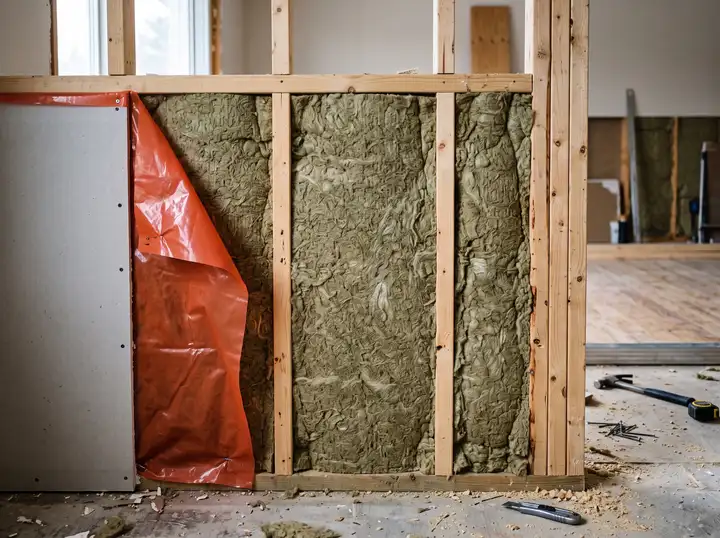
A 1970 to 1990 chalet's insulation is typically R-12 in the walls (fiberglass in 2×4) and R-20 in the attic. A Quebec main residence targets:
- Walls at R-24 minimum, often R-30 recommended by moving up to 2×6 studs
- Roof at R-40 or more, often R-50 to properly control condensation
- Double-glazed windows with argon at minimum, often triple-glazed
- Continuous, well-sealed vapor barrier
- Foundation insulation (slab on grade, crawl space or full basement) often neglected in the original build
A home renovator assesses whether walls can be filled from inside (loss of living space, less invasive) or from outside with the addition of a continuous insulation system (more expensive but much better thermal performance and extended exterior siding life).
Work site 2: central heating
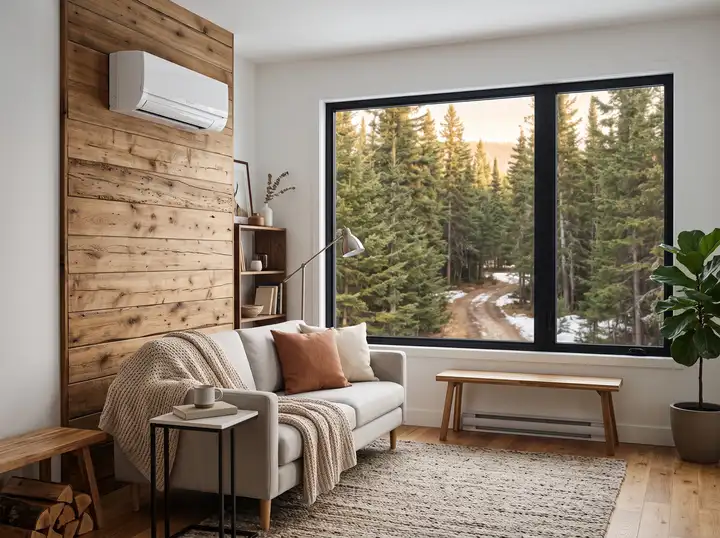
A chalet equipped only with a wood stove or fuel-burning fireplace generally does not meet the Construction Code for permanent residential use. A central heating system capable of maintaining a minimum of 18 °C without intervention must be added.
Common Quebec options:
- Mini-split wall heat pump: today's most popular, heats and cools, efficient down to -25 °C with Nordic models. Must be supplemented by a backup source below -25 °C.
- Electric baseboards and smart thermostats: simple, reliable, but expensive to operate. Well suited as backup.
- Bi-energy electricity and oil or propane system: rare today, declining.
- Central air-to-water heat pump: more expensive to install but very efficient for larger surfaces.
- Wood stove kept as backup: almost mandatory for isolated properties during extended winter outages.
A HVAC contractor assesses required capacity, unit location and available electrical. Often a chalet has a 100 A panel that needs to be upgraded to 200 A to support the new system.
Work site 3: freeze-protected plumbing
Chalet plumbing is typically designed to be drained in winter when the property is unoccupied. In a permanent residence, this draining no longer exists. Any pipe running through an unheated zone becomes a freezing risk.
Typical interventions:
- Bury the water line from the well to a frost-free depth (1.5 metres in Quebec)
- Insulate or relocate crawl space pipes to the heated interior
- Add heating cables on at-risk sections
- Install an automatic purge system in case of extended outage
- Replace the water heater if undersized (see also water heater electric, gas or heat pump)
A plumber who regularly works in vacation-home areas will know which zones to check first depending on the original construction.
Work site 4: well and septic
This is the most often underestimated item. A chalet used by four people three weekends a month does not have the same needs as a family of four living there 365 days a year.
For the well: capacity and water quality to verify. A surface or shallow well may suffice in summer but become insufficient in winter when the water table drops. Replacement with an artesian well costs several thousand dollars.
For the septic: the Q-2, r-22 standard specifies sizing according to the number of bedrooms. A 2-bedroom tank (typical chalet) does not suit a 4-person household in a main residence (3 bedrooms or more). Complete replacement (tank and leaching field) is one of the most expensive items in a conversion, particularly if the soil is not suitable (clay, rock, high water table) and requires a secondary or tertiary treatment system.
A septic system installer always first performs soil characterization (percolation test) before recommending a system type.
Work site 5: permits, tax roll and zoning
This is often the most unpleasant surprise, because it costs money without physical work.
What changes with a conversion:
- Use-change permit: the municipality may require a permit to change the declared use from "vacation home" to "main residence". This is an administrative file with plans, technical specifications and sometimes inspection.
- Property tax roll: a main residence typically has a higher assessed value than an equivalent chalet. The municipality updates the roll after the conversion, which increases municipal and school taxes (sometimes by 30 to 80 percent depending on the region).
- CPTAQ agricultural zone: if the property is in agricultural zone (frequent in Charlevoix, Lanaudière, Estrie), a residential use change requires CPTAQ authorization, with 3 to 12 months of additional delay.
- Ecological corridors and riparian buffers: if the property is near a lake, watercourse or protected zone, strict environmental rules apply to any addition.
Checking these five points before signing the purchase offer avoids nasty surprises. Some municipalities purely and simply refuse conversion for zoning reasons.
Work order: doing it in the right sequence
The logical order is:
- Complete diagnosis before purchase: soil characterization for septic, well water test, envelope and heating inspection, zoning verification.
- Foundation and envelope: see also the article on foundation waterproofing, basement or crawl space insulation, wall and roof upgrade.
- Central heating and electrical: heat pump or main system installation, panel upgrade if necessary.
- Plumbing: freeze protection, water heater replacement if necessary, outlet upgrades.
- Well and septic: often done in parallel with plumbing, with prior authorizations.
- Permits and tax roll: filed once work is complete to formalize the use change.
- Finishes and current maintenance: see annual home maintenance calendar to maintain the conversion long-term.
The general contractor's role
A conversion typically mobilizes 4 to 6 different trades. A general contractor who coordinates the whole brings very real value: they sequence interventions in the right order, negotiate with subcontractors, take global contractual responsibility and navigate permit applications. Count 15 to 20 percent of the total project value in management fees.
For an owner who wants to save by self-managing, it is possible but requires a lot of coordination, a good understanding of construction and the time to be available during weekdays. The risk: a project that drags 18 to 24 months instead of 8 to 12.
Frequently Asked Questions
What sets a conversion apart from a simple renovation?
A conversion changes the property's use (vacation home to main residence) and therefore triggers a set of regulatory obligations: use permit, tax roll update, septic sizing, four-season insulation standards. A standard interior renovation does not change the use and remains largely free of that process.
Which expense item is the largest?
It depends on the original state, but two items often stand out: complete septic system replacement when the original tank is undersized or the soil unfavorable, and complete envelope upgrade (insulation, windows, siding) when the chalet has poorly insulated 2×4 walls. Either can represent several tens of thousands of dollars on its own depending on size.
Do you have to redo the septic and well systematically?
Not automatically, but almost always to evaluate. The septic must be sized according to the number of bedrooms in permanent use (Q-2, r-22 standard). The well must supply drinkable water 365 days a year. A chalet that hosted 4 people three summer weekends does not have the same needs as a family of 4 in a main residence.
Does the municipality force me to change the use?
It normally requires a use-change permit if the property was classified as a vacation home. Some owners do not declare it to avoid the tax increase, but this is risky: in case of inspection, future sale or claim, undeclared actual use can void insurance and lead to retroactive fines.
How long for a complete conversion?
Count 8 to 12 months with a general contractor coordinating, without major surprises. Count 18 to 24 months in self-management. Major work sites (septic, complete envelope, CPTAQ permits) are often the bottlenecks.
Ready to start your project?
Describe your work, choose how many quotes you want to receive, and compare qualified contractors near you. Free and no commitment.