Driveways: Asphalt, Pavers or Concrete, What Survives Our Winters
A driveway in Quebec does not age the way it does elsewhere. Between November and April, water seeps into the smallest gap, freezes, expands by roughly 9 percent, and pushes up everything above it. Then it thaws. Then it freezes again. Dozens of times each winter in the southern part of the province.
That cycle, not tire wear or sun exposure, decides how many years your driveway lasts. Which is why choosing a material is a different question here than almost anywhere else.
Here is what each option actually becomes after ten winters, and the factor nearly everyone overlooks.
What destroys a driveway in Quebec
Three forces, in order of importance.
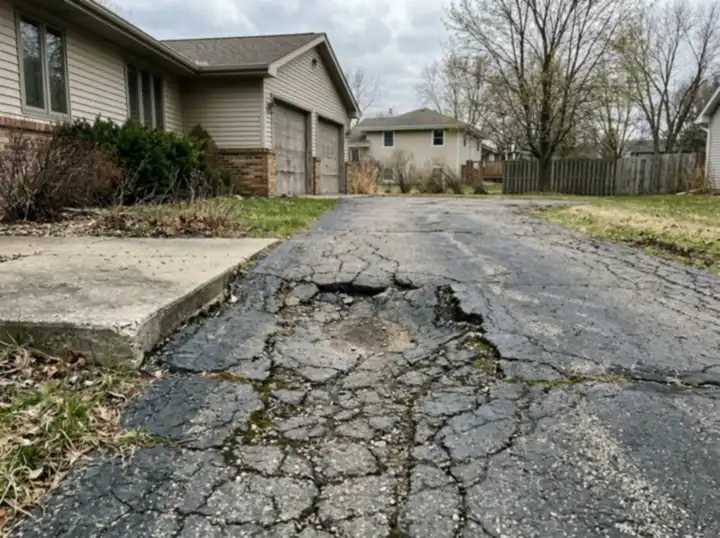
The freeze-thaw cycle. Water that gets into the surface or the base expands as it freezes. Each cycle widens the crack by a fraction of a millimetre. After three or four winters the crack is visible. After ten, it is structural.
Frost heave. If the base holds water (clay soil, poor drainage, insufficient depth), the ground itself lifts in winter and settles in spring. That is what creates humps and sunken sections, and no surface material resists it.
Salt and snow removal. Chloride attacks concrete and accelerates surface scaling. The plow blade tears at edges and at any paver that is not properly restrained.
Asphalt: cheapest up front
Realistic lifespan: 15 to 20 years with maintenance, 10 to 12 without. Cost: roughly $6 to $12 per square foot depending on access and area.
Asphalt is flexible, which is a genuine advantage in our climate: it absorbs some ground movement instead of snapping. It installs fast, one day for a standard driveway, and repairs cheaply.
Its weakness is upkeep. Sealcoating has to be redone every three to five years, otherwise UV and water break down the binder and the surface crumbles. Plenty of owners skip that step, which is why you see 12-year-old driveways that look 25.
The other limit is cosmetic. An asphalt repair always shows: the patch is darker or lighter than the original surface, and it stays that way.
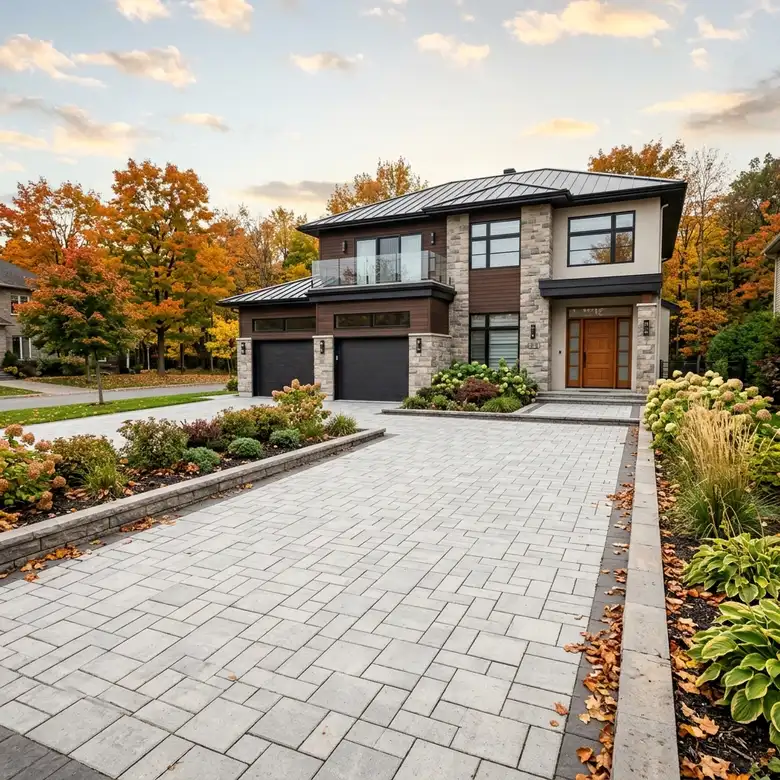
Interlocking pavers: priciest, most repairable
Realistic lifespan: 30 to 40 years, sometimes more. Cost: roughly $15 to $30 per square foot depending on paver style and pattern complexity.
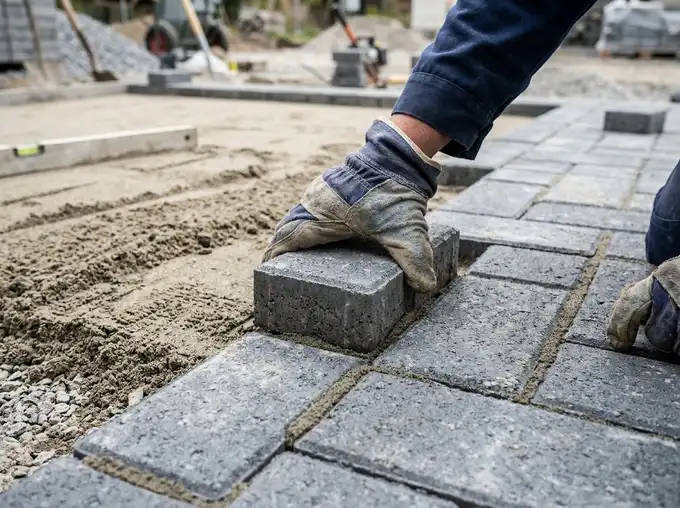
Pavers have one property the other two lack: they come apart. A localized dip is fixed by lifting the pavers, reworking the bedding sand, and setting them back. An oil stain is solved by swapping three pavers. None of that is possible on a continuous surface.
The joints also let water through, which spreads frost pressure instead of concentrating it.
The drawbacks are real. Up-front cost is two to three times asphalt. Polymeric joint sand has to be redone every five to ten years, otherwise weeds move in and pavers shift. And sloppy installation shows quickly: pavers that ripple after two winters almost always mean a poorly compacted base.
Concrete: most rigid, most at risk
Realistic lifespan: 25 to 30 years when everything is done right. Cost: roughly $12 to $20 per square foot, more for stamped or coloured finishes.
Concrete gives a uniform surface, easy to clear of snow, with a clean look many people prefer. It handles heavy loads well.
It is also the least forgiving option in our climate. A slab is rigid: it does not flex, it cracks. A crack in concrete is permanent, and a repair never blends fully. De-icing salt attacks the surface and causes scaling, especially in the first years if the slab was not sealed.
Control joints, those saw cuts at regular intervals, are not decorative: they force cracking to happen where you chose rather than at random. A slab with poorly spaced joints will crack wherever it wants.
The decision table
| Asphalt | Pavers | Concrete | |
|---|---|---|---|
| Cost per sq ft | $6 to $12 | $15 to $30 | $12 to $20 |
| Lifespan | 15-20 years | 30-40 years | 25-30 years |
| Upkeep | Seal every 3-5 yrs | Sand every 5-10 yrs | Seal every 2-3 yrs |
| Spot repair | Visible | Invisible | Visible |
| Frost tolerance | Good | Very good | Poor |
| Install time | 1 day | 3-5 days | 1 day + 7 day cure |
What matters more than the material
Here is the part most people miss: the base determines lifespan, not the surface.
A paver driveway set on six inches of poorly compacted gravel will ripple within three years. An asphalt driveway on a properly built base will last twenty. The surface is what you see, but what sits underneath is what does the work.
A proper base in Quebec means:
- Excavation of 12 to 18 inches depending on soil type, deeper in clay. That is the job of an excavation contractor when the rebuild is complete.
- A geotextile membrane between soil and gravel, to stop fine soil from migrating up and contaminating the base.
- Crushed stone compacted in lifts of six inches maximum, each one compacted separately. A single 18-inch layer compacted from the top is not compacted at the bottom.
- A drainage slope of at least 1 to 2 percent, pitched away from the house. A driveway that drains toward the foundation costs far more than a cracked one.
When you compare quotes, this is where the price gaps hide. A contractor who excavates 18 inches and compacts in lifts cannot match the price of one who spreads four inches of gravel over the crushed old surface. Both are selling you a new driveway.
Replace or repair: the markers
- Fine isolated cracks, surface otherwise sound: repair and sealcoat will do.
- Interconnected alligator cracking: the base is moving, patching will not hold, it needs rebuilding.
- Visible dips or humps: drainage or compaction problem, fix it before any new surface goes down.
- Edges crumbling along more than a third of the perimeter: end of useful life.
- Water pooling after rain: insufficient slope, worth correcting even if the surface looks fine.
Spring is the best time to assess, because frost damage has just revealed itself. Our spring home inspection guide covers the other things worth checking at thaw.
For the work itself, a paving contractor handles both asphalt and pavers, while a slab is more the territory of a concrete specialist: see concrete contractors in Montreal. Depending on your area, you can also start from paving contractors in Quebec City or paving contractors in Montreal.
Frequently Asked Questions
Which material costs least over 30 years?
Pavers, despite the higher entry price. Over thirty years an asphalt driveway will have been rebuilt once and sealed six to eight times, which catches up to and often passes the initial gap. The math changes if you plan to sell within ten years: asphalt becomes the rational choice.
Can a new surface go over the old one?
For asphalt, an overlay works if the existing surface is sound and stable, but it fixes nothing underneath: cracks typically reflect through within two to four years. For pavers, no. The old surface has to come out and the base has to be rebuilt.
What time of year should the work happen?
Mid-May to mid-October. Asphalt needs temperatures above 10 °C for proper compaction, and concrete needs several frost-free days to cure. Pavers are the most tolerant, but the base still has to sit on thawed ground. Be wary of a contractor willing to pour a slab in November.
Does de-icing salt damage every surface?
Concrete is most vulnerable, especially in its first year. Asphalt handles salt well but reacts badly to solvent-based products. Pavers tolerate salt, though whitish efflorescence can appear on the surface before fading. On a new slab, use sand or urea through the first winter.
How long does the work take?
For a standard driveway of about 600 square feet: one day for asphalt once the base is ready, three to five days for pavers, one day to pour concrete but seven days before driving on it. Add one to two days of excavation and base work in every case.
Ready to start your project?
Describe your work, choose how many quotes you want to receive, and compare qualified contractors near you. Free and no commitment.