
Landscaping Mistakes That End Up as Foundation Bills
Landscaping is the one renovation category that can damage a home's structure without anyone connecting the dots. You plant, you backfill, you build a retaining wall, everything looks great. Three years later the basement takes on water and everyone goes looking at the French drain.
The cause is often outside, a metre from the wall.
Here are the seven mistakes that come up most often, and what a well-planned yard does differently.
Mistake 1: soil higher than the foundation
The most common and the most damaging.
A concrete foundation normally stands six to eight inches above grade before the cladding starts. That visible band is not an aesthetic oversight: it is what keeps ground moisture away from the wood, the stucco, or the siding.
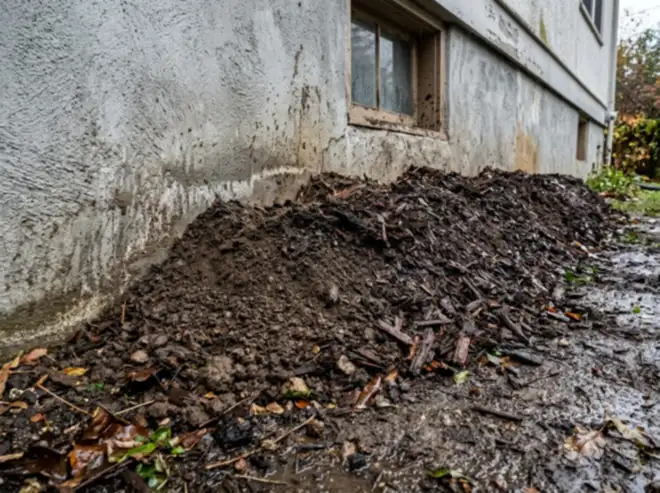
When a garden bed climbs against the wall, damp soil stays in permanent contact with the cladding. Wood rots from the bottom. Stucco absorbs and freezes. Carpenter ants get a direct entry point, because they no longer have to cross a dry zone.
The rule: always keep six to eight inches of bare foundation between finished grade and the bottom of the cladding. If your bed already covers it, the fix is to dig, not to add.
Mistake 2: grade that sends water back to the house
The ground has to fall away from the wall. It sounds obvious, yet most residential lots over fifteen years old have a grade that has gone flat or negative, because the original backfill settled.
The target: roughly 2 percent, meaning six inches of drop over the first ten feet. Below that, rain and meltwater pool at the base of the wall and run straight down to the foundation drain.
A French drain is not designed to take all the surface runoff from a lot. It handles the water table and soil moisture. Send it the surface water too and it silts up faster, as our guide on the French drain shows a few years down the line.
Mistake 3: planting a tree too close
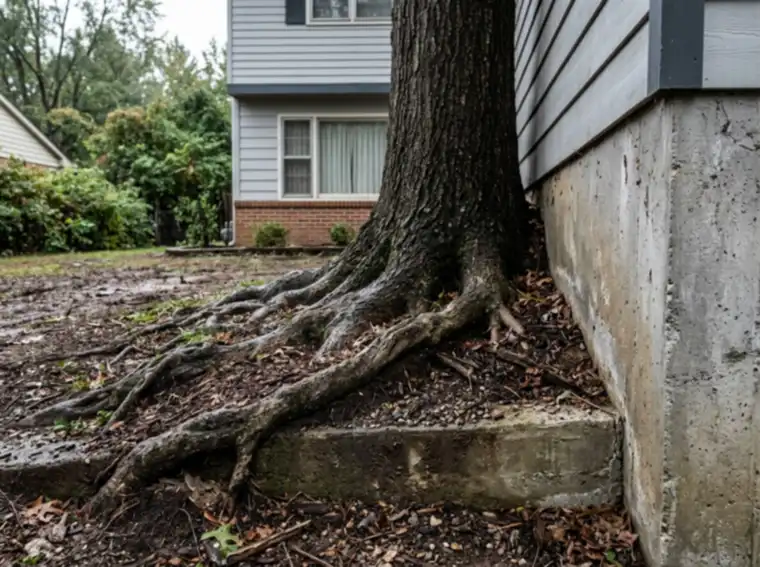
A tree looks for water. The wettest spot on a residential lot is almost always around the foundation drain.
The minimum safe distance is half the mature height of the species, and never less than three metres for a medium tree. For aggressive, water-hungry species like willow, poplar, or silver maple, count on ten metres and up.
The damage is not only roots pressing on concrete. In clay soils, a large tree dries the soil around it in summer, which moves the foundation through shrinkage, then the soil swells again in autumn. That repeated seasonal movement is what cracks.
Mistake 4: a retaining wall with no base and no drainage
A decorative block wall over a metre tall is not a stack, it is a retaining structure. It holds back waterlogged soil that freezes and pushes.
What belongs behind and beneath it: a compacted crushed stone base, a geotextile membrane, a column of clear stone behind the full height of the wall, and a drain at the base that discharges somewhere other than toward the house.
Without that, the wall bulges by the third winter. And a wall tipping toward the house redirects all the water it was holding straight at the foundation.
Mistake 5: landscape fabric under mulch
This one surprises people because it is sold everywhere.
Under decorative stone, the membrane makes sense: it stops the rock from sinking into the soil. Under garden bed mulch, it causes more problems than it solves. Mulch breaks down and forms a layer of soil on top of the fabric, where weeds settle anyway, but with roots threading through the membrane that become impossible to pull cleanly.
Worse for our purposes: fabric clogged with fine particles makes water sheet across the surface instead of percolating. On a bed running along the wall, that sends water somewhere else, often toward the foundation.
Mistake 6: burying what needs to stay reachable
The foundation drain outlet, the cleanout, the exterior backwater valve, the water shutoff: all of them eventually end up under a garden bed or a deck.
The day the drain needs a camera inspection or a snaking, whatever was built on top has to come off. Mark those access points before drawing the layout, and leave them clear.
Mistake 7: backfilling without compacting
Backfill dumped in one lift settles for two to three years. The ground drops, and a grade that was correct becomes a basin holding water exactly where it should not.
Backfill goes in six-inch lifts, each compacted separately. Same principle as under a driveway, and the same place where price gaps between quotes hide.
What a good layout does differently
Six things that cost little when planned from the start:
- Six to eight inches of bare foundation between finished grade and the cladding.
- A grade of roughly 2 percent over the first ten feet, pitched away from the wall.
- A twelve to eighteen inch band of clear stone along the foundation instead of soil. Water percolates rather than pooling, and the cladding stays dry.
- Downspout extensions reaching at least a metre and a half from the wall, two metres on a flat lot. A downspout emptying at the base of the foundation cancels out everything else.
- Cleanouts and access points left clear and findable.
- Trees placed by their mature size, not their size at the garden centre.
When a lot already has a water problem, the order of operations matters: fix the drainage and the grade before replanting, or you will pay for the landscaping twice. A landscaper in Quebec City or a landscaper in Montreal used to grade corrections will read the lot before proposing a plan. If cracks are already there, foundation contractors in Montreal come first, and our guide on foundation waterproofing covers the available methods.
Frequently Asked Questions
What grade exactly do I need around the house?
Roughly 2 percent, which works out to six inches of drop over the first ten feet from the wall. Past that band the lot can go flat again. To check it at home without instruments, rest a straight ten-foot board against the foundation and measure the gap under its free end when it sits level.
Can I put mulch against the foundation?
Better not to. Mulch holds moisture, that is its job, and that is exactly what you do not want against cladding. Use clear stone for the twelve to eighteen inches along the wall, and keep mulch for the rest of the bed.
How far from a foundation should a tree go?
At least half its mature height, and never under three metres. For willow, poplar, or silver maple, ten metres and up. Check the mature height of the species, not the size of the nursery stock: a tree sold at two metres can reach twenty.
My lot is already badly graded, do I have to redo everything?
Not necessarily. Correcting the grade over the first ten feet around the house solves most cases, and it can be done without touching the rest of the lot. That is a one to two day job on a standard house, far cheaper than redoing a drain.
Does a wall under a metre need a drain behind it?
Under a metre on well-draining ground, a compacted base and some clear stone behind it are usually enough. As soon as it retains clay, passes a metre, or sits at the bottom of a slope, the drain becomes necessary. When in doubt, install it: the cost is marginal during construction and prohibitive afterward.
Ready to start your project?
Describe your work, choose how many quotes you want to receive, and compare qualified contractors near you. Free and no commitment.