Ornamental plaster: rosettes, cornices and the heritage interior
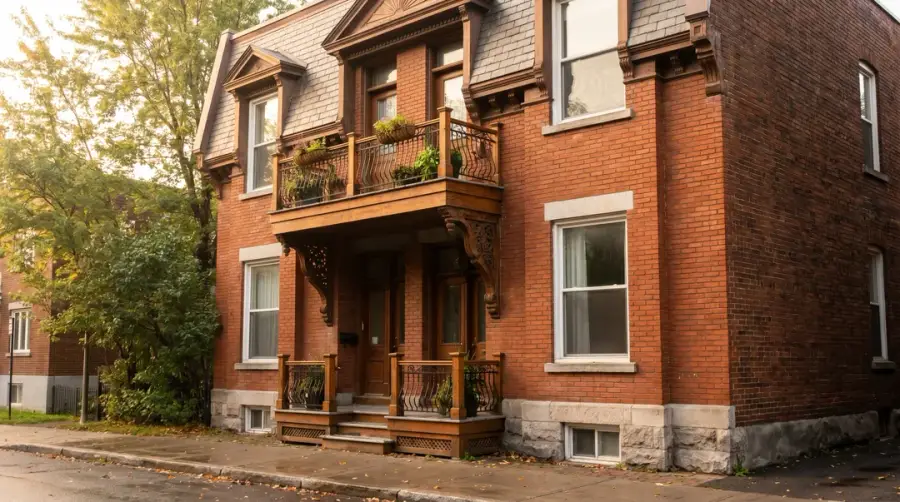
In Quebec homes built before 1930, the ceiling usually tells as much as the facade. On the facade, that role belongs to carved wood ornaments. Inside, it's the plaster that speaks: rosettes, cornices, medallions, ornamental moldings, this vocabulary adorned parlors, studies, and sometimes the main bedrooms, as a signature of social standing and craft skill.
Today, these works are quietly disappearing. They get sealed under thick acrylic paint, hidden behind suspended ceilings that cover the cracks, or demolished to run a ventilation duct. The loss is almost always irreversible and always damaging to the building's character.
Recognizing the vocabulary of ornamental plaster
Before deciding what to do, you have to know what you're looking at. Heritage interior plaster comes in five major families.
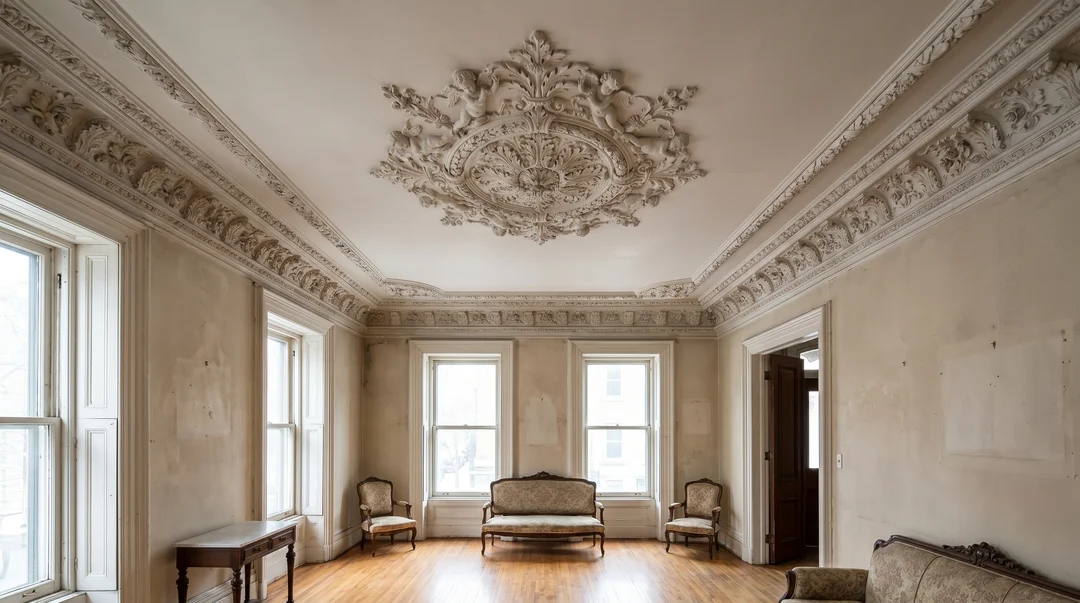
The central rosette or ceiling medallion is the most visible element. It originally marked the anchor point of a gas chandelier, later electric. Typical diameters in Quebec: 40 cm for bedrooms, up to 1.2 metres for grand parlors. Motifs range from classical floral (acanthus, oak leaf, grape) to the more geometric Victorian forms of the late 19th century.
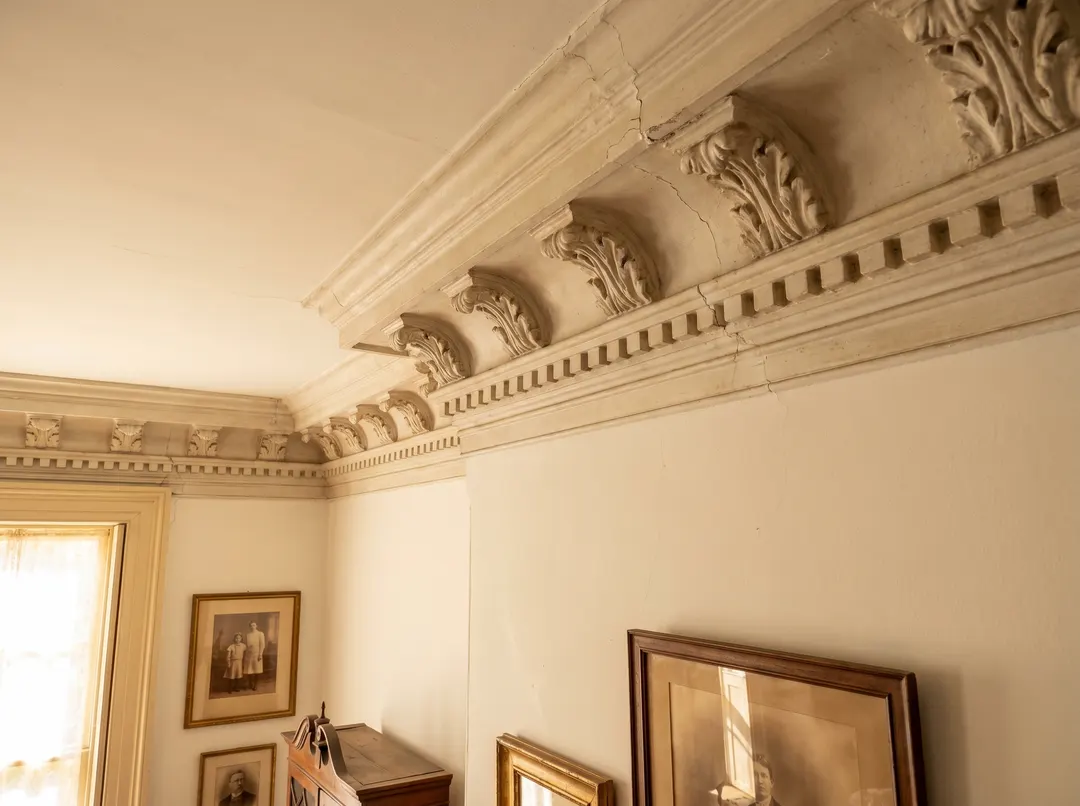
The cornice runs along the wall-ceiling joint. Its depth and complexity mark the period: a simple cove molding in modest homes, a dentil-and-modillion cornice in bourgeois ones. Dentils are the small rectangular blocks aligned under the main molding. Modillions are the larger decorative brackets, often carved with acanthus leaves.
Wall moldings include chair rails (mid-wall, separating wainscot from upper wall), ornate door surrounds, and profiled baseboards.
Friezes are horizontal ornamental bands placed under the cornice or above a chair rail.
Capitals and corbels appear at the interior corners of the most formal rooms, often inspired by the classical orders (Corinthian above all, in Quebec).
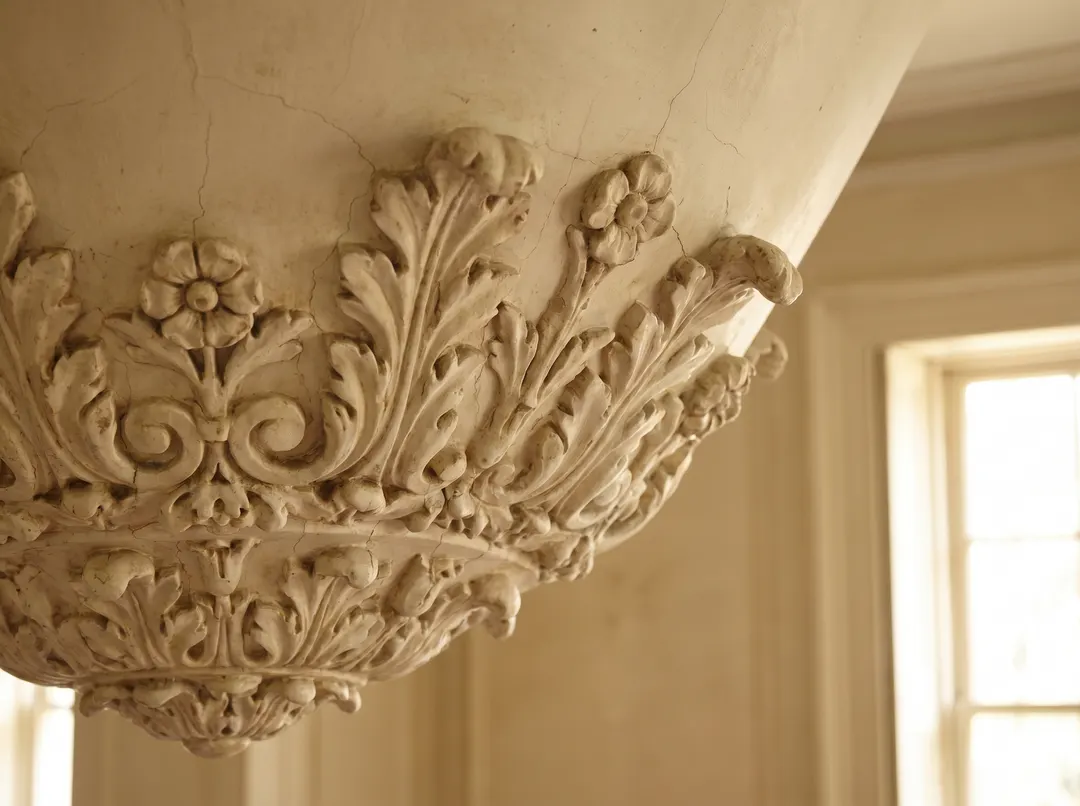
Identifying the technique: cast or hand-modelled
Heritage Quebec plasterwork is almost always a mix. Central rosettes and repeating elements (dentils, beads) were cast in plaster moulds in workshops, then screwed or nailed to the ceiling before a finisher smoothed the joints. Complex transitions and one-off details were finished by hand on site.
Three clues help date the work:
- Presence of asbestos mixed into the plaster for cast pieces: typical between 1925 and 1975. Before 1925, the mix was lime and horsehair. After 1975, modern gypsum or synthetic plaster.
- Depth and refinement of relief: mid-19th-century plaster has sharp edges and very fine detail. Plaster from the 1920s tends to be rounder, more stylized.
- Fastening method visible at the back during repair: hand-forged nails (before 1880), cut nails (1880-1920), wood screws (after 1920).
Reading the cracks: what they really say
Ornamental plaster cracks. That's its nature. But not all cracks mean the same thing.
A fine hairline crack following the grain of a molding is almost always benign. Plaster moves with the seasons, and a crack under 1 mm is cosmetic. Mark it, watch it over two seasons. If it doesn't widen, caulk it and move on.
A shrinkage crack wide at the joint between molding and wall often signals separation of the applied element. The plaster piece is pulling away from its substrate. Repairable, but it takes real skill: drill, inject adhesive resin, refix.
A structural crack running diagonally through the medallion or cornice signals something else: building movement, sometimes tied to a shifting foundation or a sagging frame. Before repairing the plaster, you have to understand the cause and address it.
A partial loss where a piece of molding has fallen: recover the fragment if possible, photograph the joint before it deteriorates further, and don't try to patch with modern gypsum. Gypsum has a rigidity incompatible with old plaster and accelerates damage in the surrounding area.
Restore rather than cover
Restoration techniques for ornamental plaster have improved markedly over the last twenty years. Three approaches dominate.
Reproduction by moulding is the noble method. From an intact section of the molding, a silicone negative is cast, then copies are pulled in fine plaster (sometimes loaded epoxy resin for high-humidity areas). The result is visually indistinguishable from the original once painted. Cost: $80 to $250 per linear metre for a standard cornice, $400 to $1,200 for a rosette.
Epoxy consolidation stabilizes cracked or detached plaster without dismounting it. A fluid resin injected by syringe migrates into the fissures and welds the fragments. Lasts 30 to 50 years if the structural cause is addressed first.
Lime-and-fine-plaster repair by an experienced heritage plasterer is the traditional technique. Slower, costlier, but it uses the same materials as the original and ages coherently. Reserved for projects of high heritage value.
What to avoid at all costs: a suspended gypsum ceiling installed below an existing rosette (the rosette is then lost forever), filling cracks with modern gypsum without prior consolidation, and thick acrylic paint in multiple coats that gradually erases the relief detail. Every removal of original decor is a direct loss of real estate market value.
Finding a heritage plasterer in Quebec
It is a rare specialty. The APMAQ (Association pour la protection des maisons anciennes du Québec) maintains a registry of recommended professionals. Heritage councils in Montreal and Quebec City publish reference lists. For specialists in heritage plaster, expect a 3 to 9 month wait depending on the season ; the best are booked a year out for major projects.
Budget for a full restoration of an ornate parlor (central rosette + 30 linear metres of cornice + 2 capitals): $8,000 to $22,000 depending on starting condition and the expected quality of execution.
Frequently Asked Questions
Can a ventilation duct be hidden behind a ceiling rosette?
Yes, but not just any way. The rosette has to be dismounted in sections, the duct routed, then the rosette reinstalled with its original fasteners or reproductions. An experienced plasterer can do the work in 1 to 2 days. Demolishing the rosette to save time destroys irreplaceable value.
Does old plaster contain asbestos?
Often, yes, in cast pieces installed between 1925 and 1975. Asbestos is locked into the material and poses no risk as long as you don't drill, sand, or break it. Before any intervention, get a test from an accredited laboratory ($80 to $150 per sample). If positive, work must be done by an asbestos-certified contractor.
Can rosettes and ornate cornices be painted?
Yes, but sparingly. Three or four accumulated coats already visibly soften the detail. Lime-based or modern mineral paints breathe and preserve the texture. Avoid thick acrylics and satin latex on heritage plaster.
How long does rosette restoration take?
For an 80 cm rosette in poor condition, plan 3 to 5 days in the workshop (moulding and casting and finishing) plus a day for installation. Larger rosettes (1 metre or more) or pieces with figures may require 2 to 3 weeks in the workshop.
Can homeowners do the restoration themselves?
Caulking a hairline crack with a flexible sealant, yes. Casting a rosette, no. The technique requires genuine expertise to hold and to stay visually coherent with the original. More heritage plaster has been destroyed by botched "repairs" than by natural aging.
Ready to start your project?
Describe your work, choose how many quotes you want to receive, and compare qualified contractors near you. Free and no commitment.