10 Myths About Old Buildings That Cost You Dearly
Introduction
Old houses get a bad reputation they don't deserve. "Too expensive to heat," "always falling apart," "not worth the investment", these beliefs drive property owners toward decisions they later regret: ripping out original windows, painting brick facades, encasing wood siding in vinyl, or demolishing buildings that could have been saved.
Heritage myths have real costs. They lead to irreversible mistakes, unnecessary expenditures, and the permanent loss of architectural character that cannot be replicated. This article tackles ten of the most stubborn myths, with facts, real numbers, and guidance from preservation specialists.
Myth 1: Original windows are too inefficient to keep
The reality: A well-maintained, solid-wood double-hung window from the 19th century, properly weather-stripped, performs far better than most people assume. The problem is never the window itself, it's its condition.
Most heritage windows suffer from dried-out weatherstripping, cracked glazing, or warped sashes. These issues are fixable for a few hundred dollars per window. Add an interior storm window, and you create a double-envelope system that rivals standard double-glazed replacement units.
Comparative costs: restoration of a wood window (weatherstripping, glazing, paint) plus an interior storm panel runs $300 to $600 per opening. A PVC replacement window with double glazing costs $800 to $1,800 per opening. The lost heritage value is incalculable.
Before committing to replacement, have your windows assessed by a joiner experienced in heritage restoration. What looks irreparable usually isn't. For more on the diagnosis, see the guide on heritage windows and doors.
Myth 2: "Maintenance-free" cladding materials are the smart choice
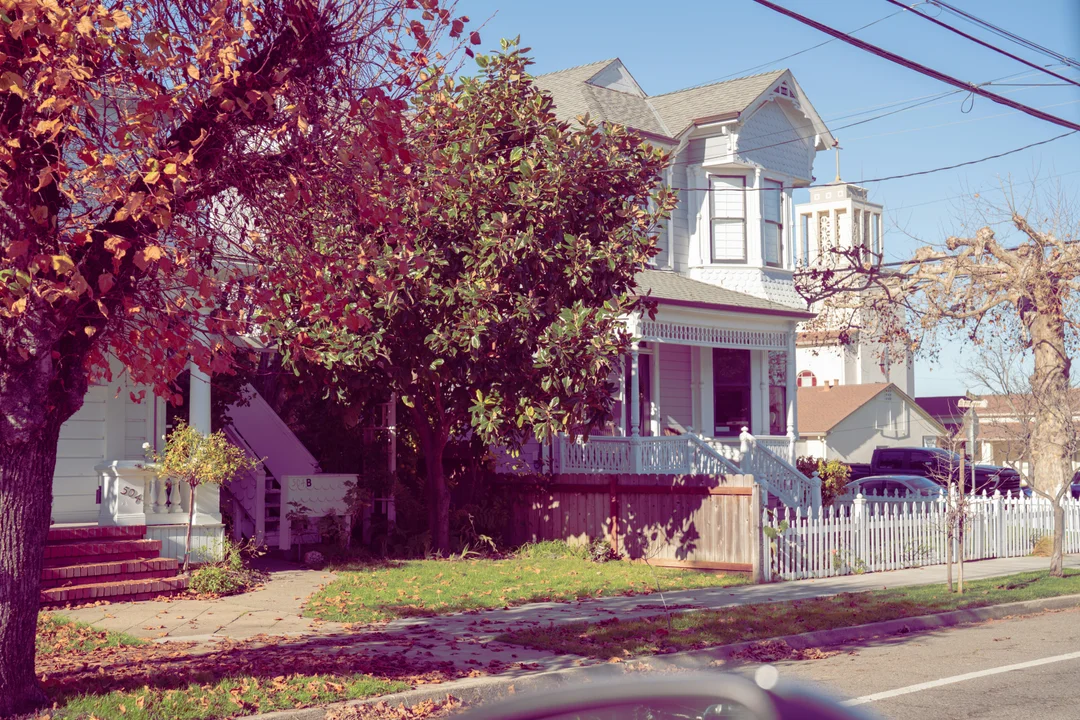
The reality: There is no such thing as maintenance-free. Vinyl siding discolours, becomes brittle in cold climates, and traps moisture against the original wood beneath, causing rot to advance unseen for years. Aluminum conducts cold and corrodes. When problems finally surface, they've often progressed far beyond what a simple paint job would have prevented.
Wood siding ages visibly. When a board starts to deteriorate, you can see it and address it. Under vinyl cladding stapled over original wood, decay can accumulate for 10 to 20 years with no visible sign. Homeowners who installed vinyl in the 1980s and 1990s are now discovering this firsthand, stripping the vinyl to find entire wall sections that need structural reconstruction.
On a heritage building, always favour breathable, compatible materials. Well-maintained painted wood siding, re-painted every 12 to 15 years, costs significantly less in the long run than encapsulated facades that trap problems.
Myth 3: Painting brick protects it from moisture
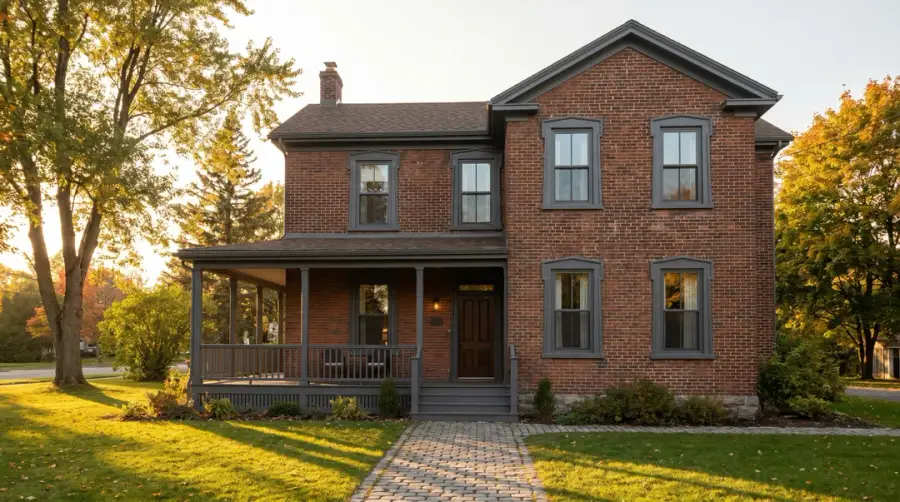
The reality: Painting masonry is one of the most destructive mistakes a homeowner can make. Old brick is a porous, breathing material, it absorbs ambient moisture and releases it freely through evaporation. That cycle is what protects it.
An impermeable paint film blocks that evaporation. Moisture stays trapped in the masonry. When temperatures drop below freezing, that water expands, fracturing the brick from within, a process called spalling. Mortar joints crack. Water infiltration follows.
Facades painted in the 1970s or 1980s frequently present critical damage today. Paint removal is delicate and costly: chemical stripping, gentle abrasive cleaning, or poultice methods, and only feasible if the brick has not already been compromised.
Old brick doesn't get painted. It gets cleaned (with appropriate, low-pressure methods), repointed when mortar deteriorates, and otherwise left to breathe. If you've inherited a painted facade, consult a masonry specialist before taking any action.
Myth 4: Asbestos-cement siding is dangerous and must be removed immediately
The reality: Asbestos-cement siding contains bound asbestos, the cement matrix encapsulates the fibres, preventing them from becoming airborne under normal conditions. Intact, undisturbed asbestos-cement poses no measurable health risk to occupants.
The danger arises during work: cutting, grinding, breaking, or improperly removing asbestos-containing materials releases fibres. It's the unmanaged intervention that's hazardous, not the presence of the material itself.
In Quebec, under the Occupational Health and Safety Regulations (RSST), any work that may disturb asbestos-containing materials requires prior characterization by an accredited professional. Removal must be performed by a certified abatement contractor.
Never remove asbestos-cement panels yourself by breaking or grinding them, it's both dangerous and illegal. Intact material can be left in place or covered in appropriate circumstances, with a certified professional handling any work that might disturb it.
Myth 5: Fungi or rot in wood means the entire structure must be replaced
The reality: The presence of wood-decay fungi is first and foremost a symptom of a moisture problem, not a death sentence for the structure. Eliminate the moisture source, and the decay stops progressing.
Old-growth timber (oak, white pine, spruce) often has greater density and natural durability than contemporary dimensional lumber. A 10-inch beam may have 3 to 4 inches of surface damage while retaining a completely sound core. Among heritage carpenters, a common working rule holds that if more than 50% of the cross-section remains sound, the member is often salvageable.
The assessment should be done by a structural carpenter or engineer. Modern diagnostic tools (moisture meters, probes, endoscopes) allow precise evaluation without extensive demolition.
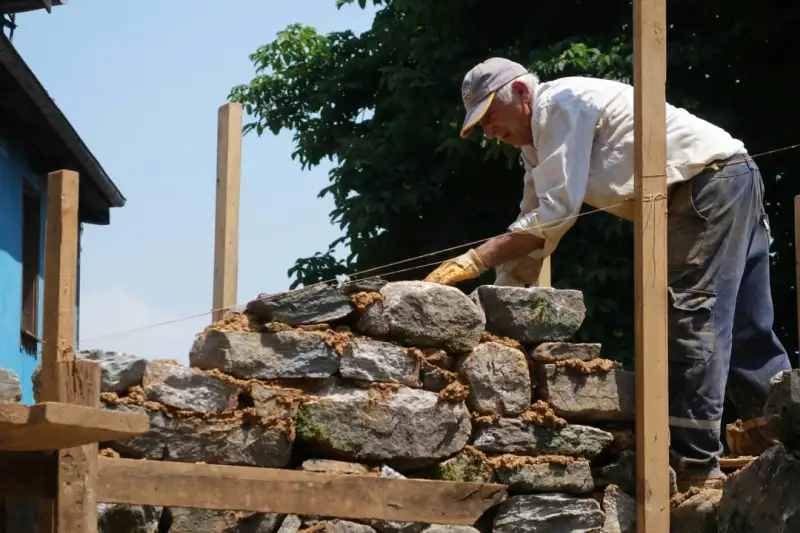
The correct approach: identify and correct the moisture source (roof, gutters, foundation, plumbing), dry out the space (ventilation, drainage), have affected members professionally assessed, then repair or replace at the minimum required. Never apply chemical treatments without specialist guidance.
Myth 6: Exposed brick or stone on interior walls is original
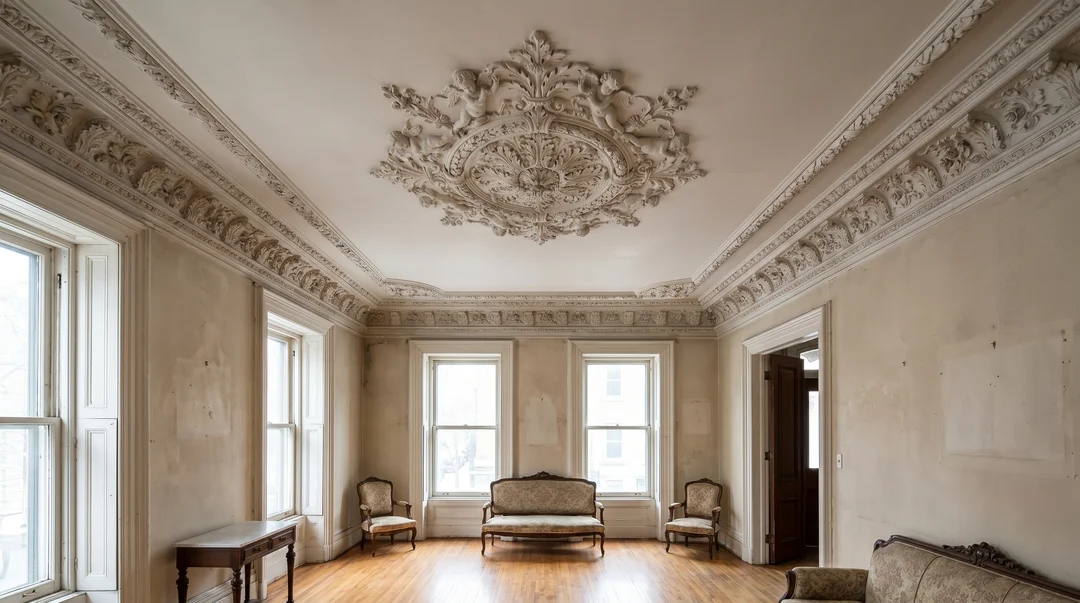
The reality: In the vast majority of pre-1920 homes, interior masonry walls were plastered. Exposed brick or stone interiors in heritage homes are almost always the result of a decorating trend from the 1970s and 1980s, when owners chipped away plaster to uncover the masonry beneath.
That removal often had unintended consequences. Plaster served as a supplementary insulator and moisture regulator. Removing it exposes masonry to greater humidity fluctuations and can contribute to condensation problems.
Where plaster survives in good condition, its restoration (using lime-based render, stucco, or traditional limewash) is far preferable to its removal.
Myth 7: Sloping floors mean serious foundation problems
The reality: Old houses settle. That's not poetic, it's physical fact. A brick or stone house built in 1890 has had 135 years to settle unevenly, shaped by soil composition, seasonal frost cycles, snow load, and dozens of other variables.
A floor that slopes a few millimetres per linear metre in an old house is often entirely normal. What warrants concern is recent movement, floors that have visibly changed since you moved in, doors that no longer close properly, plaster cracks that worsen from season to season.
Always have the situation evaluated by a structural engineer before assuming emergency. Many owners have spent tens of thousands on foundation work addressing movements that were old, stabilized, and structurally harmless.
Myth 8: An abandoned building is beyond saving
The reality: Buildings abandoned for 20, 30, or even 50 years have been successfully restored. A structure's condition is rarely as dire as its exterior suggests. What's visible (collapsed roofing, broken windows, invasive vegetation) creates an impression of total loss. But if the structure was ever reasonably weathertight, the bones may be far sounder than they appear.
The first step with any abandoned building is always a comprehensive assessment by a structural engineer and a heritage architect. Skipping this step based on assumed worst-case outcomes is a common and costly error.
Myth 9: Demolition and new construction is cheaper than restoration
The reality: This myth persists because it counts only the immediate, visible costs. Restoration of a heritage building typically costs between $150 and $350 per square foot depending on scope. New construction runs $200 to $300 per square foot, before the cost overruns that plague most new builds. Demolition alone costs $15,000 to $60,000 or more.
The equation consistently ignores several factors. Financial assistance programs: provincial heritage renovation tax credits, Rénoclimat grants, municipal assistance in historic districts, MCCQ funding programs. Market value: a restored heritage home sells at a higher per-square-foot premium than new construction in the same area, in most Quebec markets. Timelines also favour restoration, new construction takes 18 to 36 months, while restoration often takes less. Then there is the environmental footprint: demolition generates tonnes of construction waste, while restoration reuses existing materials.
Myth 10: Heritage designation means impossible restrictions
The reality: Fewer than 2% of Quebec's building stock is formally "classified" under the Cultural Heritage Act, a designation that applies to buildings of major historical significance and does impose meaningful constraints on exterior interventions.
The vast majority of old homes are not classified. They may be in a "protection zone" or a "heritage site," a far less restrictive status that requires principally prior consultation and compatibility of intervention, not a freeze on all change.
In most cases, the real constraints come down to informing the municipality before facade work, using materials compatible with the era and style, and preserving characteristic architectural elements such as dormers, cornices, and ornamental woodwork.
These constraints protect against costly mistakes, not against good work. Municipalities with heritage regulations consistently have more stable, desirable, and higher-value residential neighbourhoods.
The bottom line
Old buildings are not burdens. They are structures built to last, and they have often outlasted mid-20th-century construction by decades. Before any significant decision such as window replacement, facade treatment, or structural intervention, consult a professional with genuine expertise in heritage restoration.
A well-maintained old house, cared for with the right hands and the right materials, can stand for another century.
Frequently Asked Questions
Do heritage homes really cost more to maintain?
Not necessarily. Maintenance costs depend heavily on the building's condition and what's been done to it. An old home with original materials preserved and regular upkeep (paint, repointing, gutters, drainage) often costs less to maintain than a house renovated with inferior replacement materials that need to be redone every 10 to 20 years.
Can you modernize the interior of an old home without destroying its character?
Absolutely, and that's the norm, not the exception. Heritage regulations primarily address the exterior as seen from public space. Interior spaces are almost always unconstrained: you can update the kitchen, bathrooms, mechanical systems, and insulation without regulatory restriction. The goal is to preserve high-value interior elements like worked plaster, millwork, and period flooring that define the home's character.
How do I know if my house is classified or protected?
Check Quebec's Cultural Heritage Registry (registredupatrimoine.gouv.qc.ca) and your municipality's zoning bylaws. Your home may be within a heritage site or protection zone without individual classification. Your local planning department can confirm status in minutes.
Which professionals should I consult for an old house?
For structural matters: a structural engineer with heritage experience. For construction work: a contractor referenced by APMAQ (Association for the Protection of Historic Houses of Quebec) or certified in heritage restoration. For permits and subsidy applications: an architect or architectural technologist specializing in rehabilitation.
Are modern replacement materials always incompatible with old buildings?
Often, yes. Portland cement mortars, silicone caulks, and waterproof coatings are frequently incompatible with old masonry and wood that require breathable materials. Always verify compatibility with a specialist before applying any product to a heritage facade.
Ready to start your project?
Describe your work, choose how many quotes you want to receive, and compare qualified contractors near you. Free and no commitment.