Montreal balcony brackets: reading and restoring a heritage detail
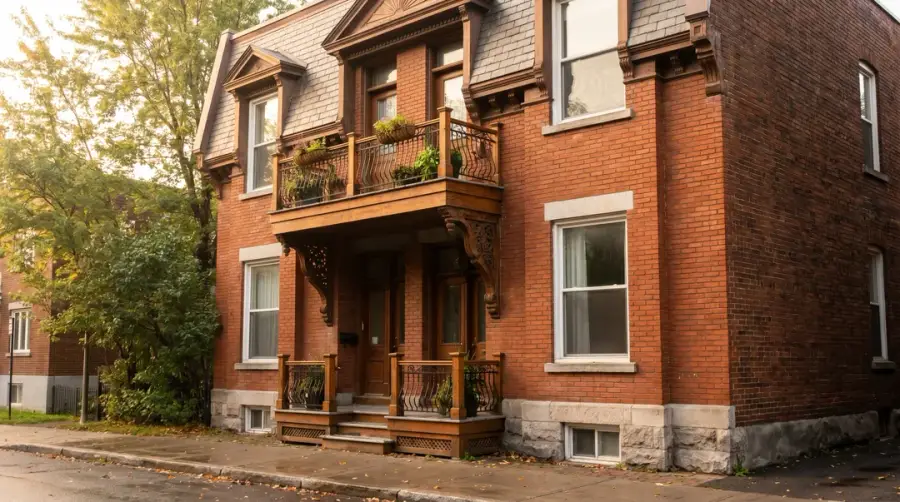
Montreal balcony brackets are one of those architectural details that make people say "oh, that's so Montreal." You see them everywhere on the Plateau, in Hochelaga, Mile End, Villeray. They're the carved wooden pieces that support the cantilevered balconies above the sidewalk, almost always in pairs or in groups of four. They look purely decorative, but they actually work: without them, the cantilever has no real structural support.
Recognizing a bracket: styles and periods
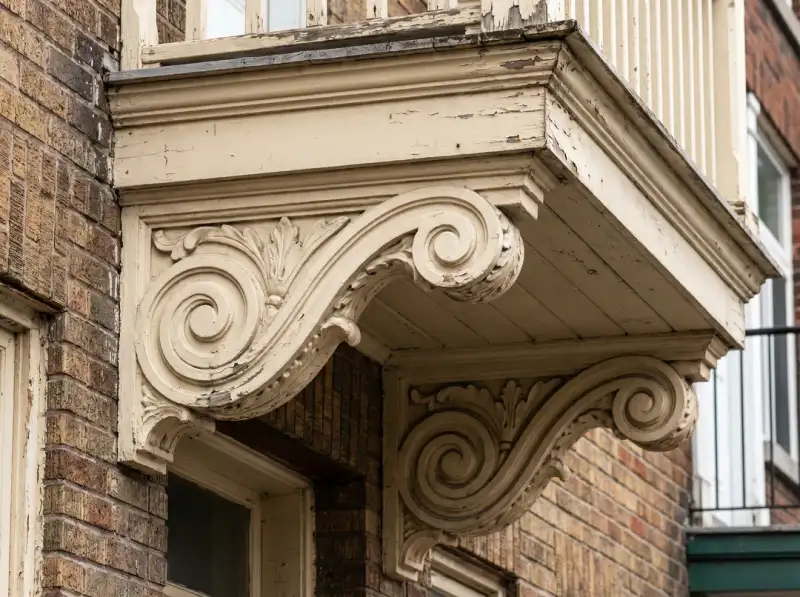
The golden age of Montreal brackets runs roughly from 1880 to 1920. Three families coexist on the Plateau's streets:
- Italianate style (1870-1900): large S-curves, sometimes stacked, often topped with carved acanthus leaves. The classic catalog bracket, mass-produced by mills like Beaver Lumber or local Saint-Henri shops.
- Neo-Greek and Eastlake (1880-1900): more geometric, rosettes, straight lines, sometimes pierced. They often age better because the surfaces hold less standing water.
- Queen Anne and late Second Empire (1890-1920): more baroque, sometimes lathe-turned, finer in profile. Often painted in two or three tones to highlight the details.
The wood is almost always local white pine, sometimes cedar. Pine isn't naturally water-resistant; it has lasted a century only because it was constantly repainted and well drained. Stop painting it, and the clock starts ticking fast.
Why they rot: the joint is a water trap
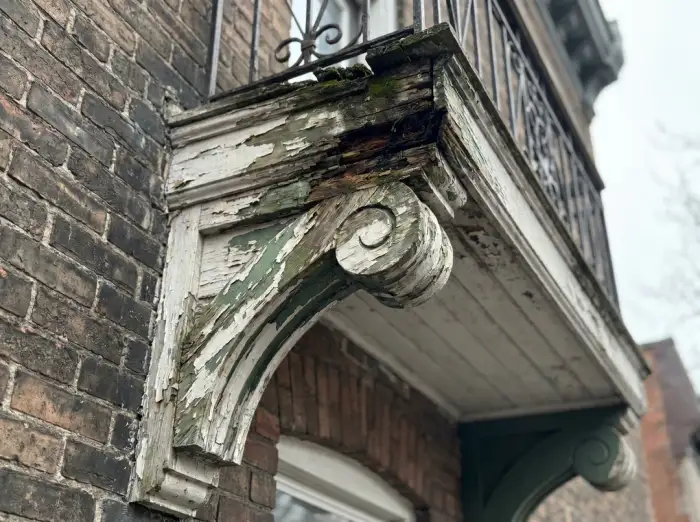
Look at any bracket that's failing: rot almost always starts at the top, where the bracket meets the underside of the balcony. Why? Because the horizontal joint between the two wood pieces traps rainwater and melting snow. Without flashing or a drip edge, moisture wicks into the grain by capillary action and never fully dries out.
Three other factors speed up the damage:
- Modern acrylic paint over old oil-based paint: the new layer doesn't breathe, water gets trapped underneath, and the wood rots silently.
- Sheet metal or TPO balcony decking, badly installed: if balcony water flows toward the bracket instead of away, you have five years.
- Gutters at the wrong angle: water bouncing off the brick wall lands back on the brackets every storm.
It's almost always the top joint that goes first. The lower portion of the bracket can hold up another 30 years if you protect it.
Restore rather than replace: what's worth saving
Rule of thumb: if the bracket still has at least 60% sound wood, it can be restored. The rest is rebuilt from intact sections using epoxy wood repair (Abatron WoodEpox is the Quebec standard) or pine grafts replacing rotted sections.
Typical process:
- Careful removal: number each bracket and photograph the joints before disassembly. Original screws are sometimes hand-forged and worth keeping.
- Chemical or heat stripping: never aggressive sanding, which destroys the scroll detail. A good professional stripper does this in shop for $200 to $400 per bracket.
- Repair and rebuild: epoxy for missing sections, grafts for full sections. An average bracket needs 4 to 8 hours of cabinetmaker work.
- Oil primer, paint in two coats: essential to restore lifespan. Traditional colors: off-white, ochre, oxblood red, dark green.
- Reinstall with new flashing: the step too often skipped, the one that wastes the rest of the work. A small copper or aluminum drip edge above each bracket doubles its life.
Budget $800 to $1,800 per restored bracket depending on starting condition, vs. $1,200 to $2,500 for a custom new copy.
When full replacement is unavoidable
If more than 50% of the wood is rotted, or if the bracket crumbles under finger pressure, replace it. Several heritage cabinet shops in Quebec produce custom reproductions from a removed bracket or precise photographs. Budget 6 to 12 weeks lead time for custom orders, and $1,200 to $2,500 per piece, installation not included.
Avoid at all costs the urethane or molded polystyrene imitations sold at big-box stores: they age badly, yellow in the sun, and the eye instantly reads them as fake. A real pine bracket costs twice as much but will outlast the imitation by 80 years, contrary to the maintenance-free materials myth.
Frequently Asked Questions
My brackets are painted industrial grey like the rest of the building. Is that right?
Historically, no. Brackets were highlighted by contrast with the brick: off-white, ochre, English green, oxblood. A bracket that disappears into the wall color betrays its ornamental role. When you repaint, separate them visually.
Are brackets protected by Montreal bylaws?
In heritage-value boroughs (Plateau-Mont-Royal, Sud-Ouest, parts of Rosemont), street-visible modifications require a permit and CCU review. Outright removal of original brackets is almost always denied. Check with your borough before any project.
How long does a full restoration take?
For 4 brackets on a typical duplex: 3 to 5 weeks in shop after removal, plus 2 days for reinstallation. Best done between May and October, never mid-winter.
Can I restore my brackets myself?
Stripping and painting, yes, with the right tools and patience. Epoxy repair takes real expertise to last 20 years instead of 3. For removal and flashing, hire a pro: a single bad fall destroys in five seconds what would cost $2,000 to reproduce.
Ready to start your project?
Describe your work, choose how many quotes you want to receive, and compare qualified contractors near you. Free and no commitment.