
French Drain: Warning Signs, Causes and Replacement Cost
A French drain is the buried drainage system around the foundation that stops groundwater from putting pressure on basement walls. In Quebec, with freeze-thaw cycles and a high water table in many neighbourhoods, a working French drain isn't a luxury, it's what keeps a basement dry. Typical lifespan is 25 to 40 years, often less in iron-ochre zones. Here's how to spot a failing drain, what causes failure, inspection and replacement costs, and how to pick the right contractor.
What a French drain does
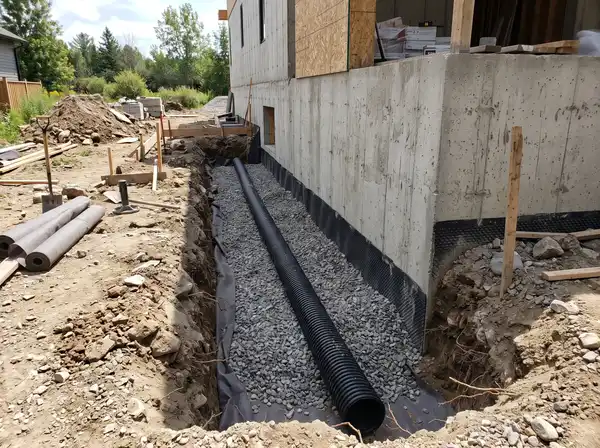
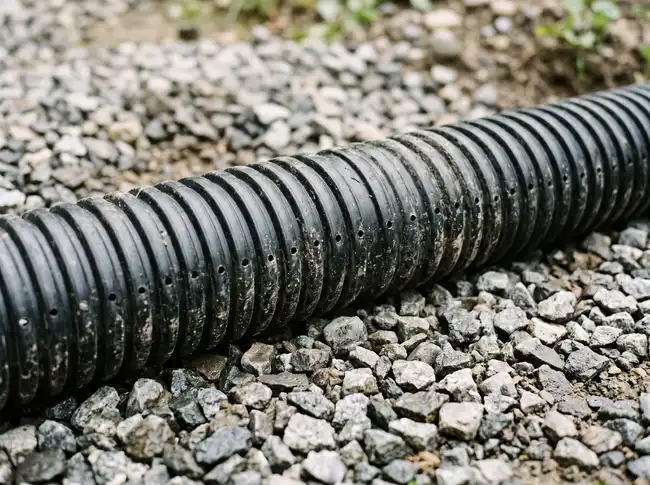
The French drain (also called foundation drain or perimeter drain) is a 4-inch perforated pipe buried at the level of the foundation footing, around the full perimeter of the house. It sits in a bed of clean 3/4-inch crushed stone, wrapped in a geotextile membrane that stops fines from clogging it. A bituminous or dimpled membrane (delta-MS type) protects the foundation wall. Groundwater accumulating around the foundation seeps through the stone, enters the drain through the perforations, and is evacuated by gravity to an outlet: ditch, street storm drain, dry well, or interior sump pit with a sump pump.
When the system works, water never stagnates against the foundation. When it fails, water builds hydrostatic pressure on the walls, seeps through cracks and joints, and the basement starts showing symptoms.
The French drain is distinct from roof drains (which evacuate gutters) and interior floor drains (which drain the basement to the sewer via sump pump). A separate article covers sewer backflow, a different issue affecting the municipal collector.
The 6 signs of a failing French drain
1. Basement water infiltration. The clearest sign. After a heavy rain or rapid snowmelt, water appears in a corner, at the base of a wall, or on the floor. Can be intermittent at first (only big rains) then chronic.
2. Chronic humidity and musty smell. The basement stays humid even in dry weather, a hygrometer shows over 60 percent relative humidity, a musty smell lingers. Water is passing through walls without reaching the floor, but evaporates inside.
3. White efflorescence on foundation walls. Whitish deposits appear on basement concrete. Salt migrates with water through the concrete and crystallizes at the surface as water evaporates. Direct sign that water is crossing the wall.
4. Foundation cracks that widen. Hydrostatic pressure from a failing drain pushes on walls. A vertical crack growing year after year, a horizontal crack (serious sign), or a wall starting to bow inward: all point to unrelieved external water pressure.
5. Paint peeling or plaster swelling. If the basement is finished, first visible signs often show on finishes: bubbling paint, drywall bulging at the base, warping baseboards. Water reaches the interior wall without being directly visible.
6. Waterlogged ground or surface settling. Around the house, ground that stays soaked long after rain, a lawn sinking near the foundation, or water surfacing under bare feet: all indicate that soil around the foundation no longer drains. The drain isn't evacuating accumulated water.
One sign justifies inspection. Two or three together, it's likely end of life.
The 5 most common causes of failure
1. Root clogging. Roots seek water and oxygen and enter through drain perforations. A maple, poplar or willow within 5 metres of the foundation is a candidate to watch. The drain fills with roots and stops draining.
2. Iron ochre (endemic to Quebec). A mix of dissolved iron in groundwater and bacteria forming a gelatinous orange deposit. Clogs the drain from inside and blocks the crushed stone. Some areas of the South Shore, Saguenay, Lanaudière and Mauricie are particularly affected. Water analysis from the sump or a camera inspection confirms the diagnosis.
3. Collapse from soil settling. Soil compacts over time, particularly after poorly compacted initial excavation. Drain slope is lost, water no longer flows by gravity. Also observed when heavy features (pool, spa, major backfill) crush the existing drain.
4. Material aging. French drains from the 1970s-1980s were often clay tile or bituminized fibre (first-generation Big-O). They crack, crumble or deform after 30-40 years. Modern polyethylene drains (current Big-O) last longer but remain vulnerable to the other 3 causes.
5. Poor initial installation. Insufficient slope (drain must drop 1 inch every 10 feet toward the outlet), missing geotextile membrane, crushed stone mixed with sand, poorly located outlet: all installation defects guarantee premature failure. Verifying that rules were followed is key when a renovation permit was issued originally.
Inspection before deciding
Don't replace a drain without first confirming it's dead. A proper cleaning sometimes fixes the problem for a fraction of the cost.
Endoscopic camera inspection. Standard method. A plumber or specialized firm feeds a camera into the drain via the access chimney (usually a vertical pipe rising to the surface). Cost: 300 $ to 800 $. The report shows: clogging level, presence of ochre or roots, pipe integrity, estimated slope.
Flow test. A measured amount of water is poured into the drain via the chimney and outflow time is measured. Slow or nil flow confirms clogging. Complements the camera.
Iron ochre analysis. A water sample from the sump is sent to a lab. Cost: 100 $ to 250 $. Results in 7-14 days. Determines if ochre is the main cause and guides the solution (regular cleaning enough or replacement inevitable).
External probing (rarely). If camera inspection isn't enough, physical probing digs at points next to the drain to visually check its state. More expensive (1 000 $ to 2 500 $) and invasive, but sometimes necessary.
The inspection report is what separates a real quote from a blind estimate. Don't sign a 25 000 $ replacement contract without an inspection report in hand.
Replacement cost in Quebec
Full French drain replacement is a major intervention: excavation around the full exterior of the foundation down to the footing (often 7-9 feet), removal of the old drain, installation of the new one, protection membrane on the foundation wall, backfilling with proper material, and surface restoration (lawn, pavers, deck, etc.).
Common price range in Quebec:
- Standard single-family home (110-140 feet of perimeter): 15 000 $ to 25 000 $
- Home with obstacles (deck, shed, mature landscaping to remove and redo): 22 000 $ to 35 000 $
- Duplex or triplex: 28 000 $ to 45 000 $
- Add 20 to 40 percent if access is difficult (townhouse with no backyard, limited machinery)
What the price should include:
- Municipal permit (often required for excavation near foundation)
- Excavation and soil disposal
- Supply and installation of the drain (4-inch Big-O, geotextile membrane)
- Foundation wall protection membrane
- Clean 3/4-inch crushed stone
- Access chimney (for future inspections)
- Connection to the existing outlet (or new outlet)
- Backfilling and compaction
- Surface restoration (lawn, seeding, pavers replaced)
- Written warranty (5 to 10 years on materials and labour)
What increases the cost:
- Back deck to dismantle and rebuild (extra 2 000 $ to 6 000 $)
- Pavers to remove and re-lay (30 $ to 45 $ per square foot)
- Shed or pool to temporarily move (variable)
- Mature tree to sacrifice or protect (500 $ to 3 000 $)
- Several trees suffering around the project = mandatory forestry engineer (500 $ to 1 500 $)
- Confirmed iron ochre = adding filter sand or automated cleaning system (1 500 $ to 4 000 $)
Cleaning only (if drain isn't finished): 500 $ to 1 500 $ per high-pressure cleaning. Temporary solution if camera inspection shows clogging without structural damage. Repeat every 2-5 years depending on cause. Not applicable to a drain with physical damage.
Subsidies in Quebec:
- City of Montreal (Rénoplex program, French drain component) offers several thousand dollars depending on income and work (confirm current amounts on the City site, they change).
- City of Quebec: occasional French drain subsidy programs (check at time of work).
- No specific provincial subsidy for French drains (unlike Rénoclimat for insulation).
- Combining replacement with foundation waterproofing methods is often recommended when excavation is already done: avoids excavating twice.
How to pick the contractor
French drain replacement attracts many opportunistic contractors who submit low bids by cutting on membrane, clean stone, or warranty. Three non-negotiable criteria to validate a quote.
1. RBQ licence with subcategory 4.1 (excavation) mandatory. Verify on rbq.gouv.qc.ca. No 4.1 subcategory, no contract, no matter the price.
2. Written warranty 5 to 10 years. On materials AND labour, with clear terms (what's covered, what isn't). A plain "1-year warranty" is unacceptable for a drain meant to last 30 years.
3. Written photo report mandatory. Photos of the old drain removed (state, cause of failure), the new installation in progress (clean crushed stone, well-laid membrane, slope verified with a level), and the backfill. These photos protect against hidden defects and prove the work followed proper standards.
Three quotes minimum, never less. The price range between the cheapest and the most expensive is often 40 to 60 percent, reflecting real differences in material quality and scope. The selection method for a contractor on a major project is detailed in the annual home maintenance calendar, which also lists documents to archive.
A qualified plumber often does the initial camera inspection and can recommend a drainage specialist if replacement is needed. Digging around the foundation then falls to an excavation contractor, for instance among excavation contractors in Quebec City or excavation contractors in Montreal. A general contractor coordinates the project when land restoration involves multiple trades (pavers, deck, landscaping).
Frequently Asked Questions
How long does a French drain last in Quebec?
Between 25 and 40 years in normal conditions. A modern polyethylene drain (current Big-O) in neutral soil without iron ochre can reach 40-50 years. A drain in ochre zones can fail in 10-15 years. Old clay-tile or bituminous-fibre drains from pre-1985 homes often reach end of life around 30-35 years.
Can you just clean instead of replacing?
Yes if camera inspection shows clogging without physical damage and without invasive iron ochre. A high-pressure cleaning costs 500 $ to 1 500 $ and buys 2 to 5 years. If the pipe is cracked, collapsed, or heavily ochre-clogged, only replacement solves it durably.
Are there subsidies in Quebec to replace a French drain?
City of Montreal (Rénoplex, French drain component) offers assistance that can reach several thousand dollars depending on income and work. City of Quebec has occasional programs to check at time of work. No specific provincial subsidy. Confirm current amounts and conditions on the city sites before planning.
Does home insurance cover French drain replacement?
Rarely. Home insurance covers damage caused by infiltration (damaged wall, soaked floor, lost furniture) per contract terms, but the drain replacement itself is almost always considered maintenance and excluded. Check your contract before work: some insurers require a functioning drain as a condition for future infiltration coverage.
Is it better to replace the drain before or at the same time as foundation waterproofing?
At the same time, almost always. Excavation represents 40 to 60 percent of total cost. Doing both in one excavation saves 5 000 $ to 10 000 $ compared to two separate projects. If the foundation wall shows active cracks or moisture, take advantage of accessibility to install a protection membrane and seal cracks while the wall is exposed.
Ready to start your project?
Describe your work, choose how many quotes you want to receive, and compare qualified contractors near you. Free and no commitment.