
Hidden Defects in Renovation: Quebec Recourse and Deadlines
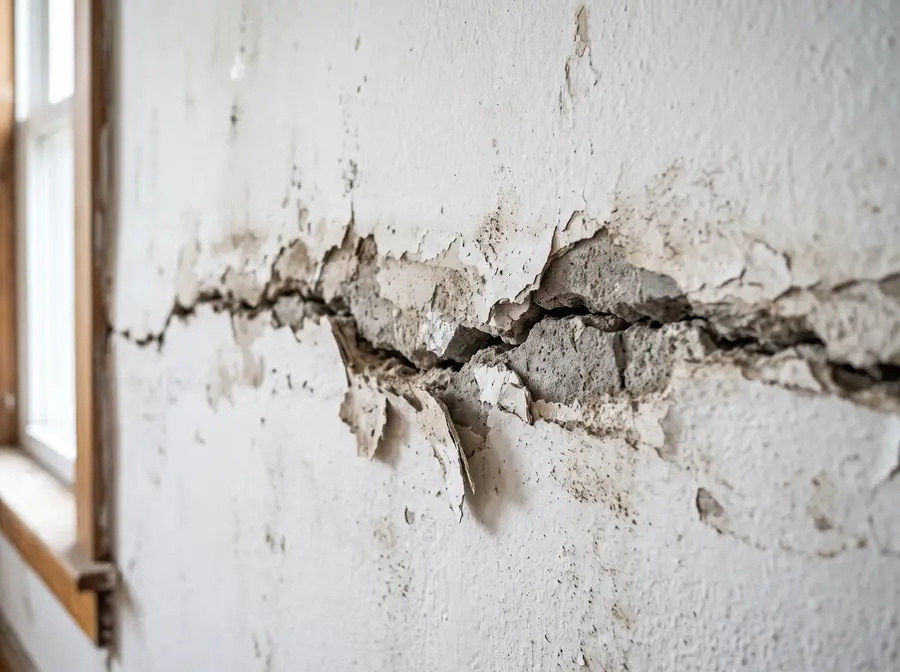
A wall that starts cracking 8 months after the contractor left. A moisture stain that comes back despite the assurances. Rotted wood under new siding. If the defect existed before the work ended but wasn't visible or reasonably detectable, it qualifies legally as a hidden defect. The Quebec regime opens real recourse, but the deadlines are short and the procedure requires specific steps. Here are the 4 legal criteria, the critical deadlines, the 3 recourse options and the exact procedure.
The 4 legal criteria (Civil Code 1726)
In Quebec, article 1726 of the Civil Code defines a hidden defect through four cumulative conditions. If even one is missing, it's not a hidden defect in the legal sense and the recourse fails.
1. The defect must be hidden. Not visible to the naked eye during a diligent inspection before purchase or completion of work. A visible foundation crack you ignored isn't a hidden defect, it's an apparent defect. A crack behind new tile installed by the contractor, yes.
2. The defect must predate completion (or sale). The cause of the defect existed before the project ended, even if the visible manifestation came later. Rotted wood under new siding existed before installation. The structural crack in the foundation didn't appear spontaneously 2 years after the work.
3. The defect must be serious. It makes the use of the property impossible or dangerous, or so diminishes its usefulness that you wouldn't have accepted at a lower price, or accepted at all. A door that doesn't close well usually isn't "serious." A foundation taking on water, yes.
4. The defect must have been unknown to the buyer. If the contractor expressly warned you about the defect (in writing) and you still accepted the work, you can't claim later. Voluntary knowledge prevails.
If all 4 criteria are met, the recourse opens. If even one is missing, the case usually collapses before deadlines are even discussed.
The critical deadlines: 6 months and 3 years
The #1 trap in Quebec hidden-defect cases isn't proving the defect, it's meeting the deadlines.
Denunciation within 6 months (case law deadline). From the moment you discover the defect OR should have discovered it (reasonable-person test), you have roughly 6 months to send a written denunciation letter to the contractor (or seller, depending on context). Case law holds that a longer delay can extinguish the right of action, except in exceptional circumstances. This letter isn't optional, it's the cornerstone of the file.
Prescription of 3 years (Civil Code article 2925). From the moment you discover the defect, you have 3 years to file the legal action. If you wait 3 years and 1 day, your right is prescribed, regardless of the file's strength. Important: this period runs from discovery, not from completion of work. A leak discovered 7 years after purchase remains actionable if you discovered it recently.
Combining both. You denounce within 6 months of discovery, and you file within 3 years of discovery. A late denunciation without excuse forfeits the right even if you're still within the 3-year prescription.
Special case: the RBQ 5-year warranty. If the contractor is under the Garantie de construction résidentielle (GCR for new builds, RBQ for major renovations), the hidden defect can be covered for 5 years after completion. The process then goes through the Plan de garantie arbitration tribunal, not civil courts. Faster procedure but with specific rules.
The 3 recourse options
Civil Code article 1604 offers three options to the buyer. You choose one, not all three.
1. Repair at the defendant's expense (article 1730). The contractor (or seller) must repair the defect at their cost, or reimburse you if you have it repaired elsewhere. The most common recourse when the defect is repairable. Requires a detailed estimate of corrective work, ideally from 2 independent contractors.
2. Reduction of the price paid. You keep the property as-is and claim a reduction of the price paid corresponding to the value gap between what you paid and what the property is worth with the defect. Used when repair costs more than the reduction, or when the contractor is insolvent. Requires a property appraisal to quantify the loss.
3. Contract rescission (rarely granted). You return the property and get your money back. Reserved for cases where the defect is so serious you would never have accepted the contract. Rarely used in renovation because dismantling a kitchen to return to original state makes no sense. Applicable in real estate sales in extreme cases.
The choice depends on the relative cost of each option, technical feasibility, and the other party's solvency. A competent lawyer in real estate or construction law guides you toward the option that maximizes actual recovery.

The step-by-step procedure
Step 1: Document the defect. Dated photos, videos, temporary repair invoices, statements from professionals (plumber, electrician) who observed it. The more precise the documentation, the stronger the file. Keep paper AND digital copies.
Step 2: Written denunciation letter. Within 6 months of discovery. Sent by registered mail with delivery receipt. Content: description of the defect, discovery date, explicit demand (repair, reimbursement, or request to inspect). Keep the receipt. Templates available from ACQC and Éducaloi.
Step 3: Formal demand letter. If the contractor doesn't respond or refuses, a demand letter (usually prepared by a lawyer) gives a final deadline (10 to 30 days) to respond or act before judicial action. Cost: 150 $ to 500 $ via lawyer, or 0 $ with free template.
Step 4: Independent expert assessment. A qualified building expert (structural engineer, technologist, inspector) writes a detailed report establishing the defect, its likely cause, and the estimated repair cost. Cost: 800 $ to 3 500 $ depending on complexity. This report is the evidentiary basis for the judicial procedure.
Step 5: Choice of forum. Depending on the amount in play: Small Claims Court (up to 15 000 $, no lawyer, 1 to 2 years delay), Court of Quebec civil division (15 000 $ to 100 000 $, lawyer recommended), Superior Court (above that). For cases covered by the RBQ Warranty, it's the Plan de garantie arbitration tribunal.
Step 6: Mediation or trial. Before trial, many files settle in mediation (mandatory procedure for Small Claims Court since 2018). Typical total delay between denunciation letter and final decision: 1.5 to 4 years depending on forum and complexity.
To build a solid defence, keep the renovation permit from the project (proof of code compliance), the documentation from the annual home maintenance calendar (proof you did your checks), and the original quotes (the method for comparing contractor quotes suggests archiving everything). These 3 documentation sources prove essential before a judge.
Useful Quebec resources
ACQC (Association des consommateurs pour la qualité dans la construction). Non-profit Quebec organization specializing in disputes between homeowners and contractors. Free phone advisory service for members, procedure support, letter templates. acqc.ca.
Éducaloi. Free plain-language legal information platform. Excellent section on hidden defects and the 5-year warranty, with decision trees to guide you to the right recourse. educaloi.qc.ca.
Régie du bâtiment du Québec (RBQ). To verify the contractor's licence, file a complaint (an RBQ report can influence pressure on the contractor without constituting a legal recourse on its own), and get information on the 5-year Warranty. rbq.gouv.qc.ca.
Lawyer specialized in construction or real estate law. First meeting free or reduced fee (50 $ to 150 $) at many firms. Beyond that, plan 250 $ to 450 $ per hour. For files under 30 000 $, some lawyers accept a percentage mandate (15 to 25 percent of recovered amount).
Certified building inspector. If the defect isn't obvious, a professional inspector (AIBQ or ANSIB member) can produce an initial report (300 $ to 800 $) that determines if a recourse is plausible before engaging a more expensive expert.
For the choice of repair contractor after winning the case, a home renovator or general contractor coordinates the full restoration.
Frequently Asked Questions
How long after the work can a hidden defect be invoked?
Prescription is 3 years from discovery of the defect, not from completion of work. Theoretically, a hidden defect discovered 10 years after the work remains actionable if you denounce within 6 months and file within the next 3 years. In practice, judges are stricter on proving defect anteriority the more time passes.
Do you need a lawyer for a hidden defect case?
Not mandatory in Small Claims Court (up to 15 000 $). Strongly recommended for Court of Quebec civil division (15 000 $ to 100 000 $) and effectively mandatory for Superior Court. For an initial consultation, many lawyers offer a free or reduced first meeting, which often suffices to validate file viability.
Hidden defect vs RBQ 5-year warranty: which applies?
If the contractor is under the Garantie de construction résidentielle (new builds) or holds an RBQ bond for major renovation, the 5-year warranty covers hidden defects and the recourse goes through the Plan de garantie arbitration tribunal. Generally faster and less costly than civil courts. For other cases, the civil hidden-defect recourse applies.
Is an expert assessment mandatory?
Not strictly mandatory in Small Claims Court, but in practice almost always required to win. The judge needs an expert to qualify the defect as "hidden defect" legally and quantify damages. An inspector's report (300 $ to 800 $) suffices for simple cases, an engineer's report (1 500 $ to 3 500 $) is needed for structural defects.
If the contractor closed their business, can you still recover anything?
Difficult but not impossible. Three avenues: (1) personal liability of directors in cases of bad faith, (2) the RBQ bond if the contractor was licensed, (3) professional civil liability insurance if the contractor had it. A specialized lawyer evaluates viability before investing in procedure.
Ready to start your project?
Describe your work, choose how many quotes you want to receive, and compare qualified contractors near you. Free and no commitment.