
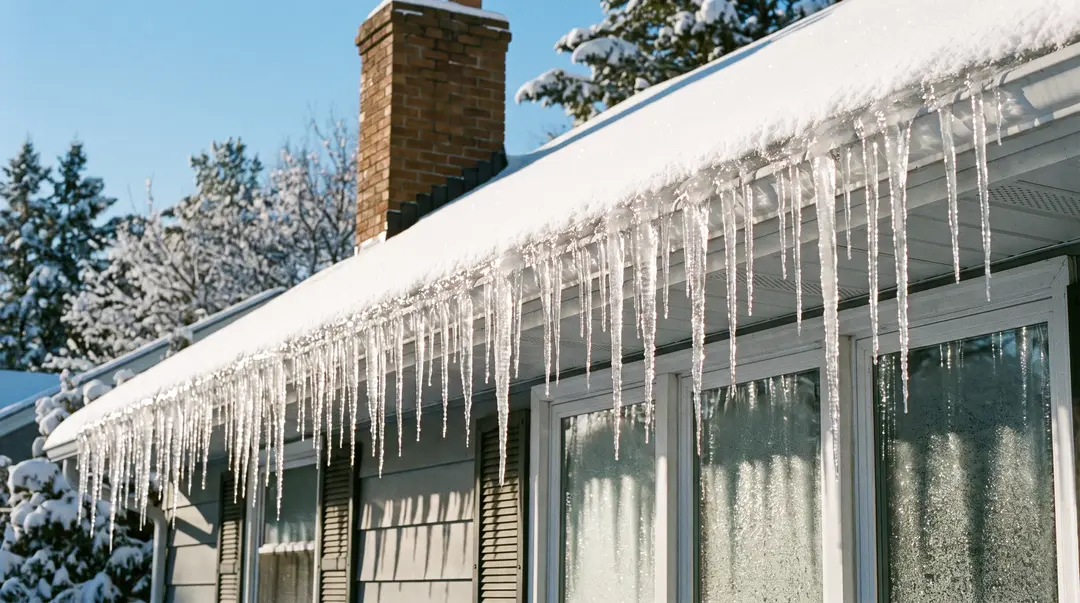
Ice Dams: Why the Problem Is Not on Your Roof
The row of icicles hanging off your eaves in February photographs well. Behind it there is almost always a ridge of ice several centimetres thick, and under that ridge, water backing up beneath your shingles.
The instinct is to call a roofer and have the roof repaired. In the great majority of cases, that is not where the problem is.
How an ice dam forms
The mechanism is always the same, and it starts inside the house.
- Heat escapes from the heated rooms into the attic.
- That heat warms the roof deck from below. The snow sitting on it melts, even at minus fifteen.
- The meltwater runs down the slope.
- When it reaches the overhang, which projects past the wall and is therefore heated by nothing, it meets the cold again and freezes.
- Ice builds up and forms a dam. The water still arriving pools behind it.
Step five is the expensive one. An asphalt shingle is built to let water slide downhill, not to hold back a puddle. When water sits behind the dam, it wicks up between the shingles and gets through.
Why a new roof fixes nothing
A new roof with the same thermal conditions underneath will produce the same dams next winter. You will have spent several thousand dollars to postpone the problem by a year.
What a new roof changes is the damage, not the cause. The self-adhering membrane laid along the bottom of the slopes, now standard on new roofs in Quebec, stops trapped water from getting through. The dam still forms, it just no longer leaks inside. That is protection, not a cure.
So the real question is not whether your roof is worn out, but why your attic is warm. If your roof covering is near the end of its life anyway, this is the right moment to combine both jobs, and our article on when to replace your roof covers the signs to watch.
The three causes, in order of importance
1. Air leaks. By far the first, and the most overlooked. Warm humid air from the house rises and passes through every unsealed opening into the attic: the access hatch, recessed lights, the gaps around plumbing stacks, partition walls left open at the top, and worst of all, the bathroom fan that vents into the attic instead of outdoors. One of these alone can be enough.
2. Not enough insulation. Even with no air leaks, insulation that is too thin lets heat through by conduction. The classic weak point is the perimeter of the ceiling, right above the exterior wall, where the space narrows and the insulation is crushed or missing. That is exactly the spot sitting over the overhang.
3. Attic ventilation. Its job is to carry off residual heat so the roof deck stays at outdoor temperature. It does not correct the first two problems, it partly compensates for them.
The order matters. Adding ventilation to an attic that is leaking warm air just pulls harder on the heated air inside the house. Serious insulation contractors always start with air sealing, and our guide to home insulation covers which zones come first.
Ventilation: from soffit to ridge
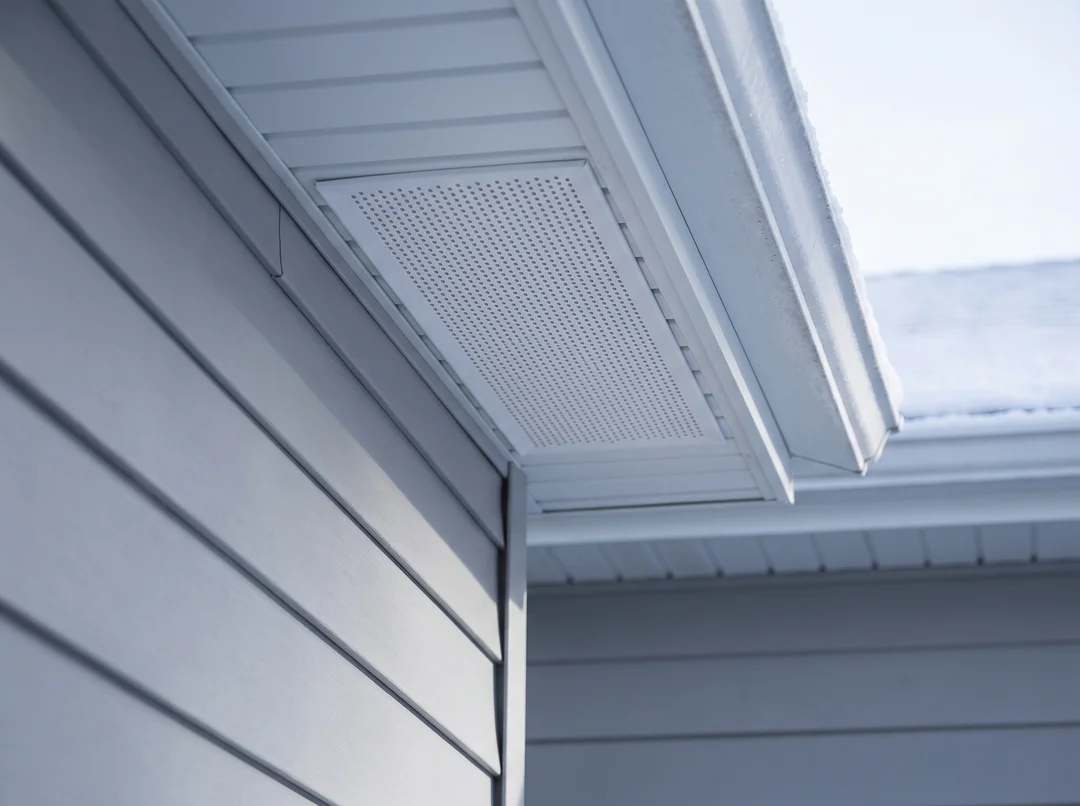
Attic ventilation works by circulation. Cold air enters through the perforated soffits under the overhangs and leaves at the top, at the ridge or through roof vents. If either half is missing, nothing moves.
The most widespread defect in Quebec is easy to spot: the soffits are there, but blown insulation has been pushed right to the edge and buries them completely. Baffles installed between the rafters fix that and cost little.
The second common defect is roof vents installed partway up the slope only, with no intake at the bottom. Air leaves, but nothing comes in.
Signs to recognize
- Icicles that return every winter in the same spot, thickest above one particular room
- Snow melting in patches on your roof while your neighbour's stays covered
- Streak marks on the exterior cladding, under the overhang
- Frost on the underside of the roof deck, visible in the attic in very cold weather
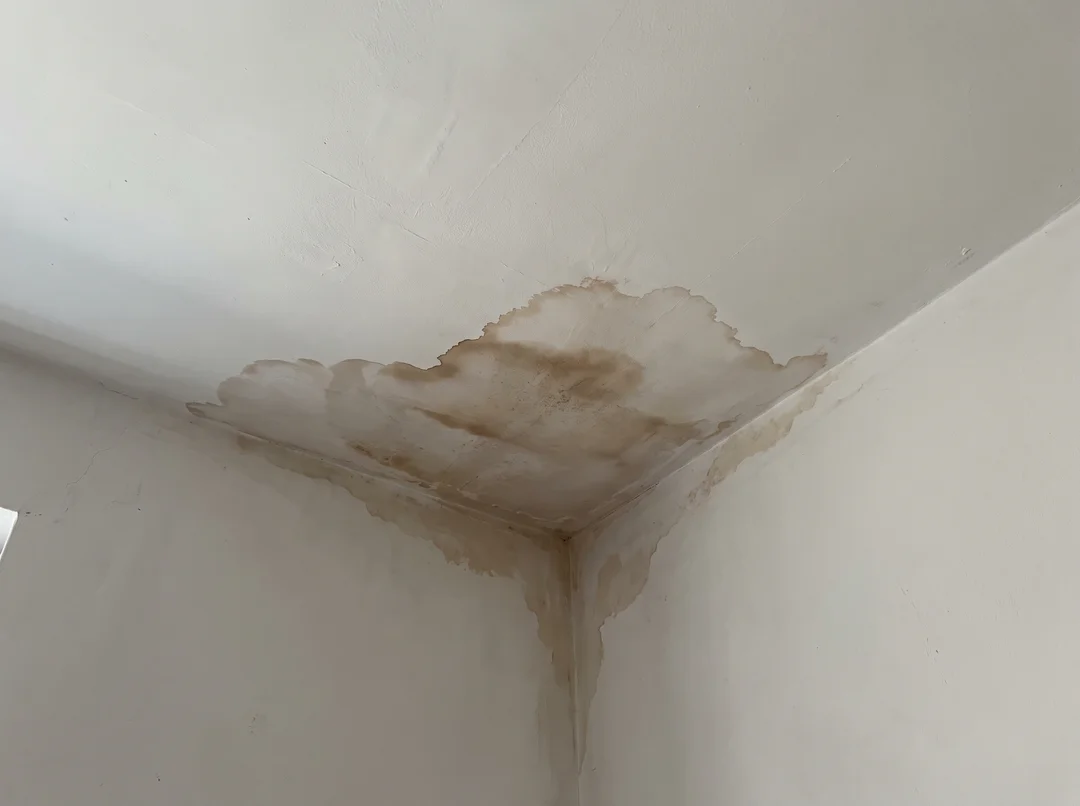
- A stain appearing on a ceiling or at the top of a wall, often in a corner
Uneven snowmelt is the most useful sign, because it shows up before the damage does. A thermally healthy roof keeps its snow.
What not to do
Chopping the ice with an axe or hammer. You will split shingles and puncture the membrane, and you will find the hole in spring.
Spreading de-icing salt in the gutters. It attacks aluminum, flashing metal and the plants underneath.
Installing heat cables and calling it solved. They keep a channel open through the ice and prevent the worst during a crisis, but they burn electricity all winter and never touch the cause. As a stopgap on a house waiting for work, fair enough. As a final answer, no.
Climbing onto an icy roof. People fall every winter. A roof rake used from the ground clears the bottom of the slope with no risk, and that is often enough to get through a thaw.
Where to start
In this order, because each step makes the next one work better:
- Have the air leaks found in the attic, and check first where the bathroom fan actually discharges.
- Seal the access hatch and the gaps around stacks and recessed lights.
- Clear the soffits and install baffles if insulation is blocking them.
- Top up the insulation to the intended depth, paying attention to the perimeter above the exterior walls.
- Add ridge ventilation only once the first four are done.
The first four cost a fraction of a new roof and settle most cases.
A roofer is the right person to assess the covering and lay the membrane along the eaves, but ask what they see on the ventilation side too. Many of these problems take two trades to fix. In the metropolitan area, our list of roofers in Montreal is a starting point, and the inspection belongs in the fall, alongside the rest of winterizing your house.
Frequently Asked Questions
Are icicles always a sign of trouble?
Not always. A few short icicles after a sunny thaw are normal. What is not normal is a thick row returning every winter in the same place, or a ridge of ice that settles on the overhang and stops melting.
Should I remove the snow from my roof?
Not for the load, except after exceptional accumulation on a long span. Clearing the bottom of the slope with a rake from the ground helps limit a dam in progress, but it only buys time. The cause is still the heat rising.
Does my insurance cover ice dam damage?
Often yes for sudden interior damage, but it depends on your policy, and an insurer can refuse if the problem is old and known. Repeated infiltration over several winters gets treated as a maintenance failure rather than a claim.
Can a new house get ice dams?
Yes, and it happens often. A poorly ventilated cathedral ceiling, an unsealed access hatch or a bathroom fan discharging into the attic is enough. The age of the building matters less than the quality of the air sealing.
What does fixing it cost?
Far less than a roof. Sealing air leaks, clearing soffits and topping up insulation in an ordinary attic stays in the hundreds or low thousands, against tens of thousands for a new covering that would not address the cause anyway.

Post your project
Describe your work once, and contractors in your area who do this kind of work can get back to you. It's free, with no commitment.
Post a project