Welded aluminum decks: benefits, limits and cost
When it's time to repair or replace your balcony, welded aluminum keeps coming up in the conversation. The material started its Quebec career on commercial and institutional rooftops, where its light weight and corrosion immunity gave it a clear edge over galvanized steel. Over the past five to seven years it has moved into residential at scale, replacing pressure-treated wood and composite decks. The 25-year warranty, the maintenance-free reality, and the fact that the whole structure lifts off as a single piece have sold homeowners who are tired of resealing their balcony every two years.
Welded vs bolted aluminum
Not all aluminum structures are equal. Two families exist in residential.
Bolted (or screwed) aluminum. Extruded profiles assembled in shop or onsite with bolts, rivets and corner plates. Faster to fabricate, cheaper to buy, available from more suppliers. The downside: every joint is a mechanical weak point and a potential water trap. Over 20 years, the bolts loosen slightly with thermal cycles, and water sitting in the joints can eventually pierce the protective paint.
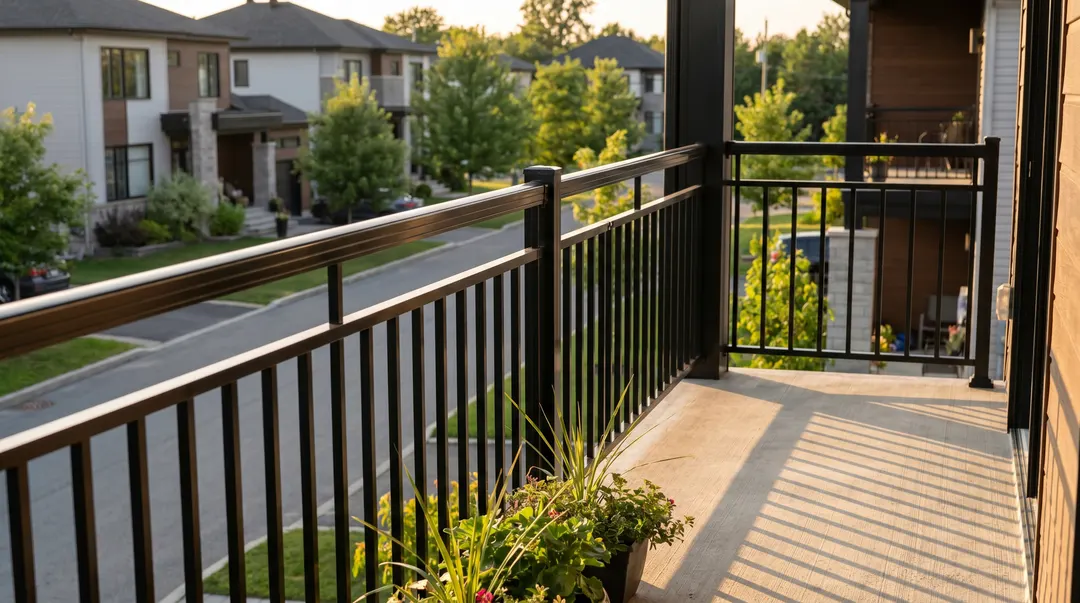
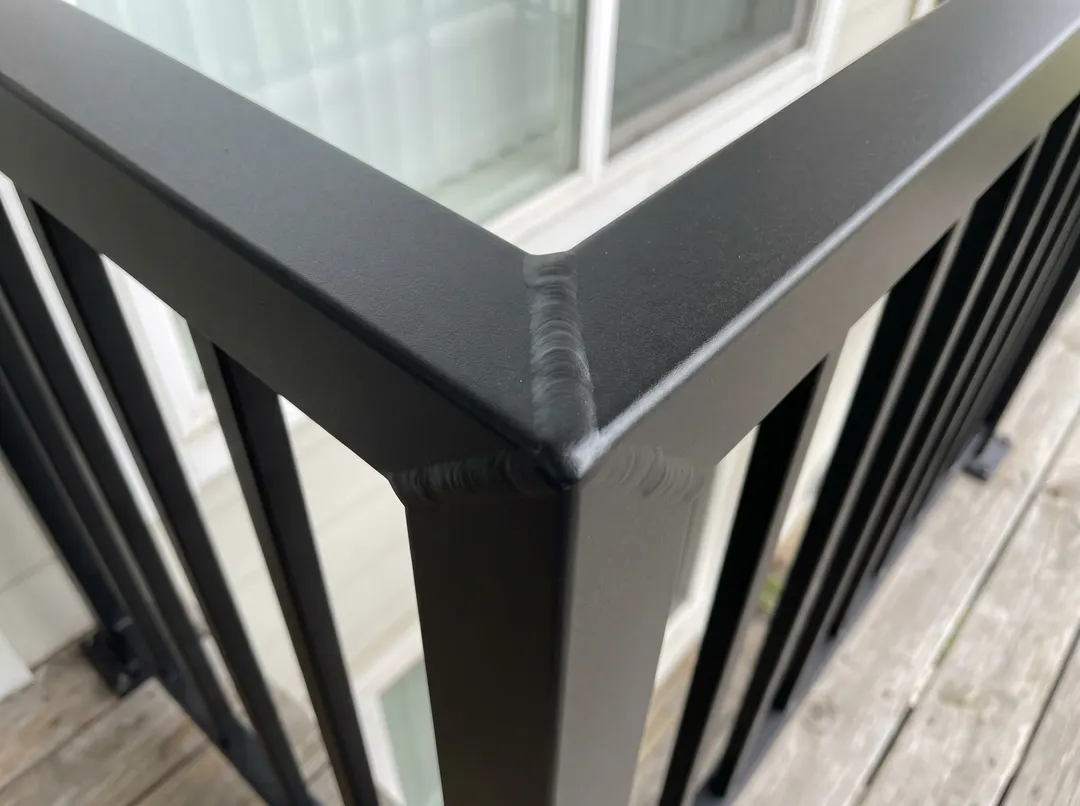
Welded aluminum. The profiles are TIG-welded in a specialized shop, then the whole assembly goes through a baked-paint oven. The result is a monocoque structure, no mechanical joints, paint applied over cooled welds. More expensive to produce, requires aluminum-certified welders (a rare qualification), but it gives you 25 to 30 years with no intervention.
When a supplier says "aluminum structure," they almost always mean the bolted version. Welded is a distinct product you have to ask for explicitly and verify on the quote.
Technical advantages
Weight. An 80 sq ft residential balcony in welded aluminum weighs about 180 kg fully assembled. The same balcony in pressure-treated wood weighs 350 to 450 kg, and in concrete exceeds 1500 kg. The reduced weight opens up installation on rooftop terraces, on cantilevers, and on structures where wood would make the main house deflect.
No rust. Aluminum doesn't oxidize the way galvanized steel does. The natural oxide is passive and self-protecting. Even if the baked paint were eventually scratched, the metal underneath won't degrade.
Baked-paint finish. The profile is degreased, sandblasted, chemically treated, painted, then baked at roughly 200 °C for 20 to 30 minutes. The coating polymerizes onto the metal and resists UV, moderate impact, and thermal cycling. Typical warranty: 20 to 25 years against chipping, chalking and discoloration.
25-year warranty. Covers both structure AND finish. This is the quality marker to verify on the quote. A short warranty (5 to 10 years) almost always signals a bolted structure with cold-applied paint, not true welded.
Welded aluminum vs wood and composite
Pressure-treated wood (spruce or hemlock). 40 $ to 60 $ per square foot installed. Sealer every 2 to 3 years (about 200 $ per pass). Full redo at 12 to 15 years (5 000 $ to 8 000 $ for 80 sq ft). Total cost over 25 years: roughly 80 $ to 100 $ per square foot.
Western red cedar. 70 $ to 95 $ per square foot installed. Oiling every 3 to 4 years. Partial redo at 20 years. Total cost over 25 years: 90 $ to 115 $ per square foot.
Composite (Trex, Timbertech). 85 $ to 110 $ per square foot installed. Minimal upkeep. Board lifespan 20 to 25 years. Wood or aluminum substructure underneath needs to be maintained separately. Risk of thermal expansion in summer and creaking in winter. Total cost over 25 years: 95 $ to 130 $ per square foot.
Welded aluminum. 110 $ to 160 $ per square foot installed. Occasional wash. No redo before 25 years. Total cost over 25 years: 110 $ to 160 $ per square foot (the purchase price is the final cost).
Over 25 years, welded aluminum isn't the cheapest upfront, but it stays competitive with composite, and the gap with wood narrows once you include sealing labour and full replacement. The calculation tips toward aluminum when you factor in the hours you don't want to spend on the balcony anymore.
Where welded aluminum really excels
Over a living space below. A bedroom balcony above the living room, or a terrace above a kitchen, demands a waterproof and removable structure. Welded aluminum delivers both: fully sealed surface and the ability to lift the whole assembly to redo the waterproofing membrane underneath.
Rooftop terrace on an urban triplex. A flat roof gets redone every 25 to 30 years. With a wood deck, the membrane redo means full demolition of the terrace. With a welded aluminum structure, the roofer lifts the terrace off as a single piece, redoes the EPDM or TPO membrane, and the terrace goes back. Savings of 8 000 $ to 15 000 $ per cycle.
Medium-term resale. A transferable 25-year warranty is a concrete selling point, especially on a duplex or triplex investment property where every poor-condition balcony knocks 5 000 $ to 15 000 $ off the asking price.
Limits to know before signing
Industrial look. Painted aluminum reads as crisp and industrial. Many heritage-home owners reject the aesthetic, and several boroughs forbid it outright in heritage zones. If you want the look of oiled wood developing a patina, aluminum will never deliver that. For neighbourhood permit rules, see the guide on renovation permits.
Upfront budget. The floor is roughly 5 000 $ to 7 000 $ for a small entry porch. For a ground-level balcony on a tight budget, pressure-treated wood is unbeatable upfront.
Spot repairability. A cracked wood plank swaps out in 20 minutes. A welded aluminum section dented by a heavy object needs to go back to the shop or be cut and welded onsite, which is doable but costs more than a wood repair.
Cost and upkeep in practice
2026 average installed prices in Quebec:
- Small entry porch (30 to 50 sq ft): 5 000 $ to 9 000 $
- Standard residential balcony (60 to 100 sq ft): 8 500 $ to 16 000 $
- Rear terrace (100 to 200 sq ft): 14 000 $ to 28 000 $
- Full rooftop terrace with perimeter railing (200 to 400 sq ft): 28 000 $ to 55 000 $
Time from signature to install: 8 to 14 weeks, most of which is shop fabrication. The install itself runs 1 to 3 days for a residential balcony, up to a week for a larger terrace.
Maintenance over 25 years: one annual wash with mild soap and water. No chemicals, no sanding, no paint touch-ups except spot accidents.
When picking the contractor, ask for the welder's certification (CWB or equivalent), the exact paint process (oven-baked, with the actual temperature), and the warranty term in writing. The methodology in the guide on comparing contractor quotes applies hard here: the spread between a serious fabricator and a reseller of poorly presented bolted structure can hit 30 percent on products that have nothing to do with each other in terms of lifespan. A general contractor can coordinate the welder, the roofer (if a roof sits below) and the installer. For the structure itself, a deck contractor takes the project on directly: see deck contractors in Laval or deck contractors in Quebec City.
On return on investment, a welded aluminum balcony doesn't fall into the profitable renovations bucket on a short timeline (3 to 5 years), but past the 10-year mark, the transferable warranty and zero maintenance translate into resale value.
Frequently Asked Questions
How much does a welded aluminum deck cost?
For a standard residential balcony of 60 to 100 sq ft installed and finished, plan for 8 500 $ to 16 000 $. A full rooftop terrace with perimeter railing (200 to 400 sq ft) lands between 28 000 $ and 55 000 $. The price depends mostly on fabrication complexity (shapes, angles, stairs), not so much on floor area.
What's the actual lifespan?
The standard warranty is 25 years on the structure and the baked paint. Effective lifespan often exceeds 30 years with occasional washing and no chemical maintenance.
Do I need a permit to install an aluminum deck?
Yes, same as for any residential terrace that changes dimensions, structure or the exterior appearance visible from the street. Heritage zones often restrict modern materials, so check with the municipality before signing.
Is welded aluminum really maintenance-free?
Chemically, yes. No sealer, no stain, no repainting. The yearly wash with mild soap removes dust and pollen. That's all.
Can a welded aluminum structure go on an old concrete balcony footing?
In most cases, yes, provided the concrete block is sound and the load-bearing capacity is confirmed. If the footing is crumbling or cracked, plan for its replacement too (1 500 $ to 4 500 $ extra depending on depth).
Ready to start your project?
Describe your work, choose how many quotes you want to receive, and compare qualified contractors near you. Free and no commitment.