The Roof: The Architectural Personality of an Old House
Introduction
The roof is the first thing nobody notices. We walk past old buildings and see the windows, the brick, the ornamental woodwork, but our gaze stops at the cornice line. Yet it's the roof that gives a building its deepest identity.
In old Quebec neighbourhoods (Vieux-Montréal, Limoilou, Saint-Roch, the Plateau, Outremont) the rooftops tell architectural history better than any heritage plaque. The pitch of a roof, its form, its materials, its dormers: each detail reveals the period of construction, the owner's means, the chosen architectural style, and the demands of the climate.
To understand the roof is to understand the building itself.
The Major Roof Forms of Quebec
The Gable Roof
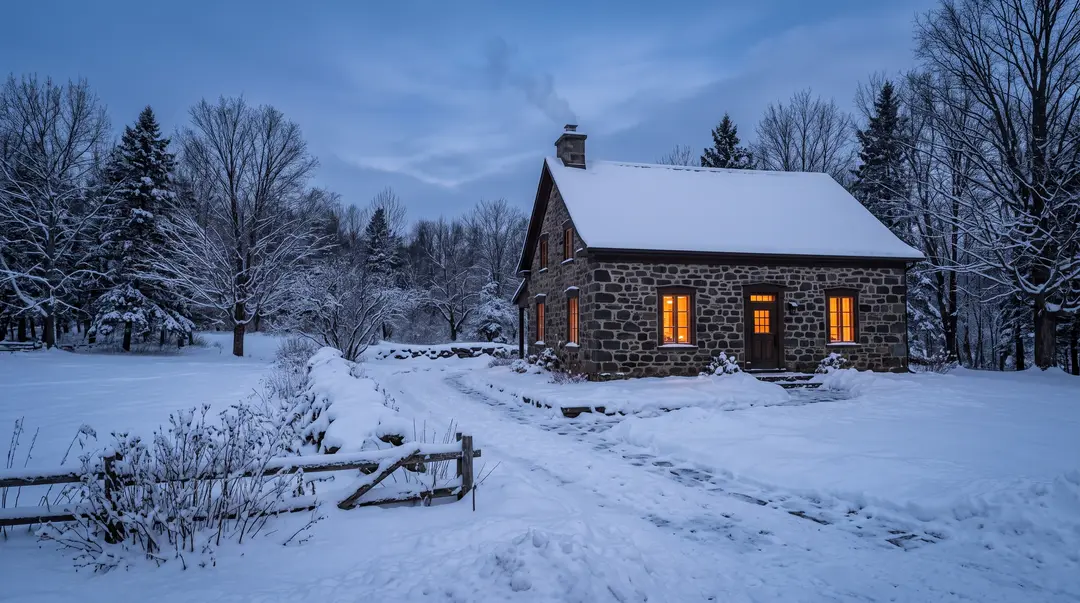
The oldest and most prevalent form. Two sloping planes meeting at a ridge line. Simple, efficient, universal. It appears throughout Quebec's vernacular architecture, settler homes, barns, rural buildings of every type.
Pitch varies considerably. A steep angle (60 degrees or more) often signals an 18th or early 19th-century construction, it created liveable attic space beneath. A gentler slope generally indicates later construction or renovation.
The gable roof may be completed by ornamental gable ends. On Victorian homes, these are often decorated with elaborate sawn woodwork, the famous "dentelle de bois" or wooden lacework.
The Hip Roof
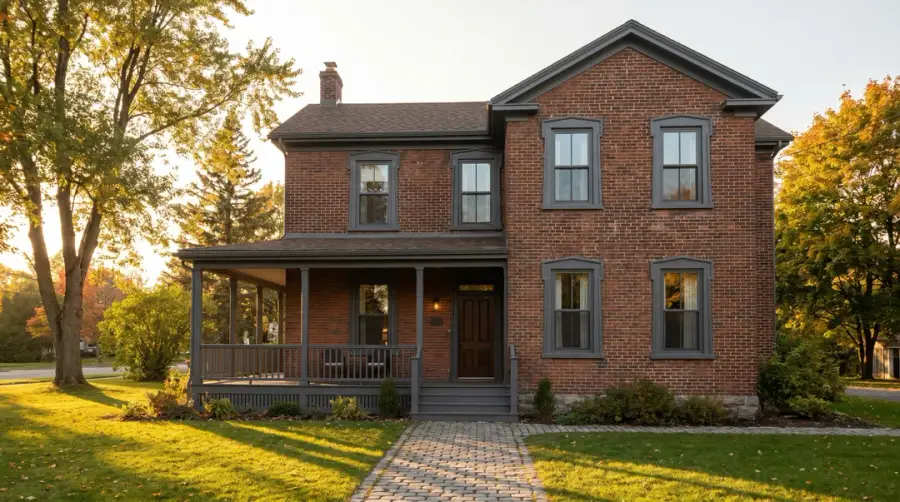
The hip roof eliminates the vertical gable ends: all four sides of the house are covered by sloping planes. The result is a more massive, more solemn profile. Hip-roofed homes convey stability and permanence.
This form appears frequently on 19th-century prestige homes, merchants' properties, rural manors, wealthy townhouses. The full hip roof requires more material and labour than a gable, making it a traditional marker of prosperity.
A common Quebec variant: the half-hip, where only the extremities are sloped, with a reduced gable at the apex. Often found on rural homes of the 18th and 19th centuries.
The Mansard Roof
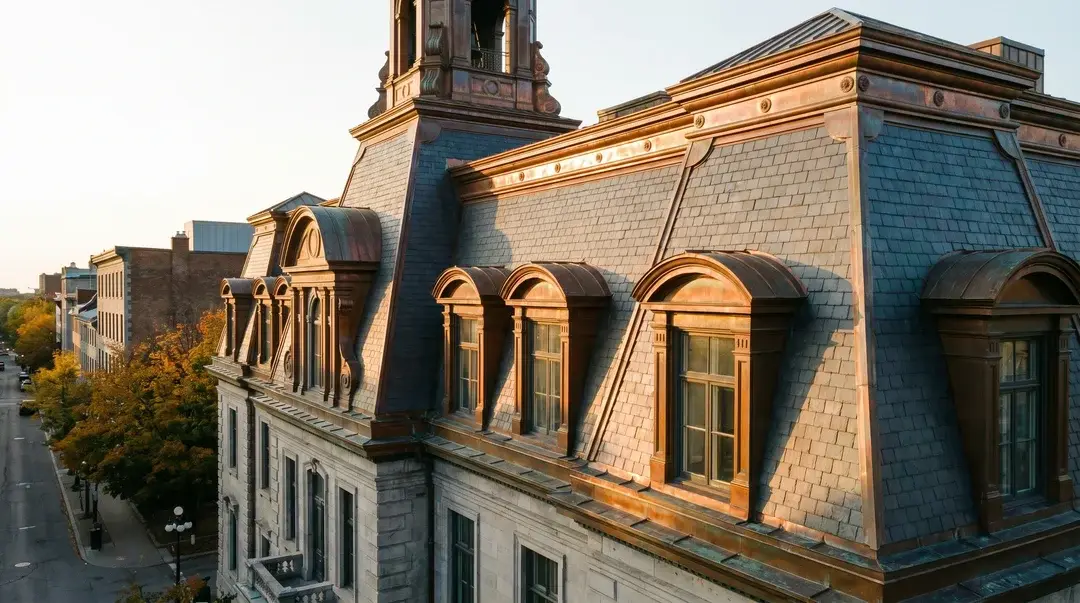
The mansard roof is the iconic form of urban Quebec. Named for French architect François Mansart (1598-1666), who popularized it in France in the 17th century, it crossed the Atlantic with settlers and embedded itself deeply in the Quebec architectural landscape.
Its defining feature: two slopes on each face. The upper slope is nearly vertical, dropping sharply from the ridge. The lower slope is more gently inclined. This creates vast liveable attic space, making it popular for maximizing habitable area without exceeding regulatory height limits.
The Second Empire style (1850-1880) brought the mansard roof to its peak. It's recognized by its decorative dormers piercing the upper slope, ornamental zinc or cast-iron details, and elaborately worked cornices.
The False Mansard
The false mansard is the architectural sleight-of-hand of the Plateau Mont-Royal, and countless other working-class Quebec neighbourhoods built between 1880 and 1930.
The building actually has a flat roof. But the street-facing facade features a vertical cladding (wood siding, embossed tin, or brick) that visually mimics the vertical slope of a true mansard. Seen from the street, these buildings appear to have a full upper floor under a genuine mansard. In reality, it's a decorative shell.
This solution answered economic constraints (a flat roof is cheaper to build) while respecting neighbourhood aesthetic codes. It's also one of the most common sources of confusion for homeowners, who discover they have a flat roof where they expected a pitched one.
Essential maintenance: the waterproofing of a flat roof beneath a false mansard must be inspected regularly. The space between the decorative facade and the flat roof is vulnerable to water accumulation and rot if drainage isn't perfect.
The Flat Roof
Long confined to industrial buildings, the flat roof invaded residential construction with the triplex and duplex buildings mass-built in Montreal between 1900 and 1940. Economical, quick to install, it provides rooftop access, an advantage Montreal tenants still appreciate today.
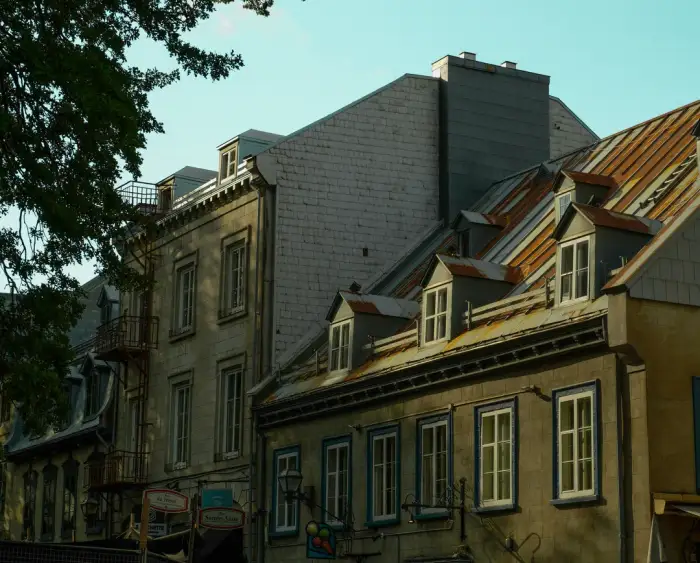
Structurally, a flat roof is never truly flat: it slopes slightly (1% to 3%) toward drains or gutters for water flow. That slight slope is critical. A poorly drained flat roof accumulates water, freezes, and causes massive infiltration.
Flat roof membranes (TPO, EPDM, modified bitumen) have a service life of 15 to 25 years. Annual inspection is essential, particularly around penetrations: ventilation pipes, chimneys, drains.
The Pavilion Roof
The pavilion roof is a perfect hip: four equal slopes meeting at a single central point rather than a ridge line. Also called a pyramid roof. It gives the building a square, centred, solemn presence.
Found primarily on public buildings (old post offices, rural town halls), presbyteries, and certain bourgeois homes of the late 19th century. Corner turrets, very common in Quebec's Victorian architecture, use this form at a smaller scale.
Roofing Materials
Roof form defines architectural identity. The covering material determines character and longevity.
Natural Slate
Natural slate is the benchmark roofing material for heritage buildings. Cut into thin plaques, it's durable, non-porous, frost-resistant, and under normal conditions, virtually eternal. Slate roofs a century old are still found in perfect condition.
Natural slate costs $20 to $50 per installed square foot, but its service life often exceeds 100 years. Sources include Spanish, Welsh, American (Vermont), and Canadian slate. Colours range from blue-grey to green, purple, and black. For a heritage building, it's the authentic choice.
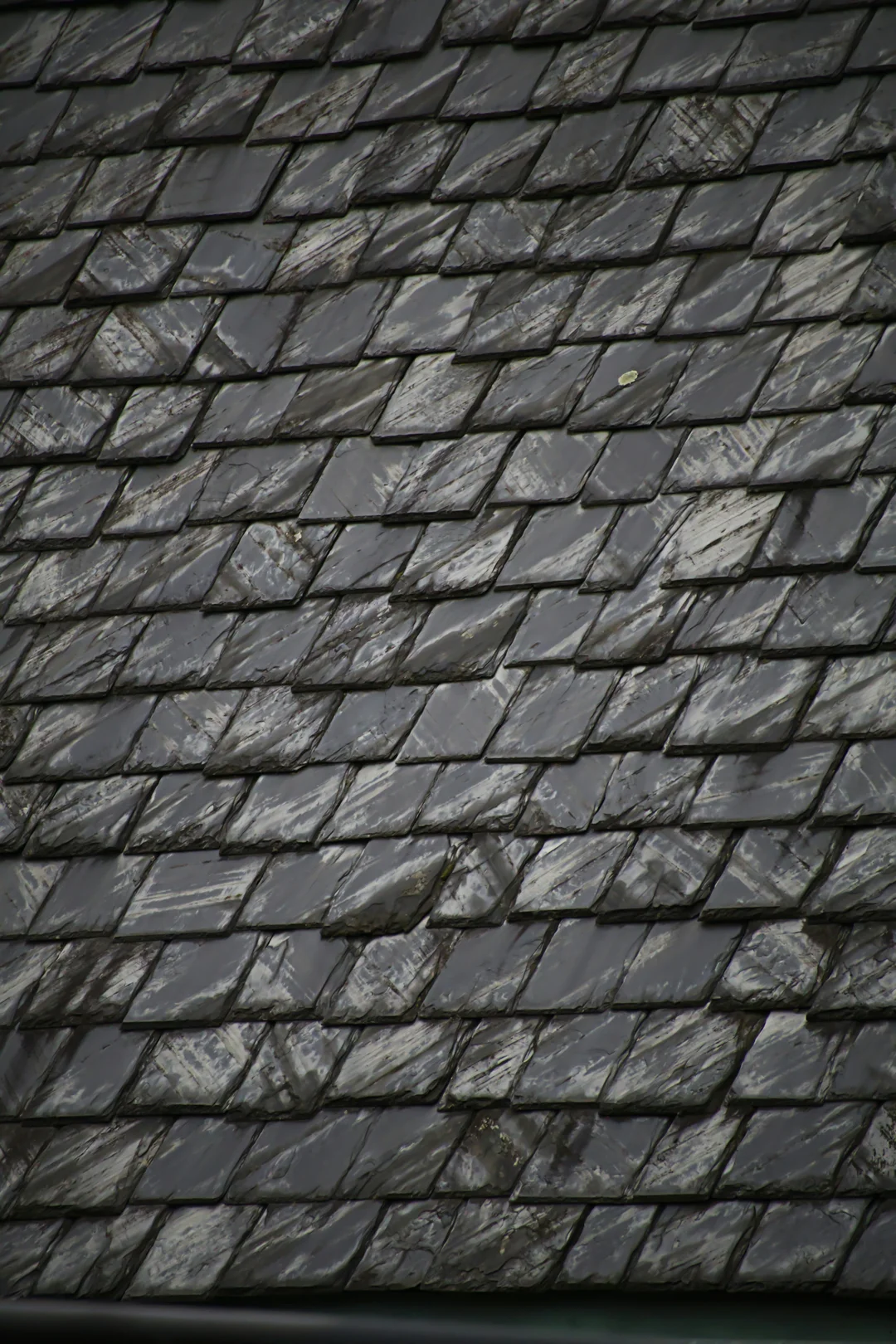
Slate is never painted or treated. It's replaced (piece by piece) when individual slates crack, slip, or break. The fixing method (copper or stainless nails) is more critical than the slate itself: it's typically the fixings that fail first.
Standing-Seam and Rib-Panel Metal Roofing
Folded metal sheet is the signature of Quebec rooftops. Recognized by its parallel raised ribs or flat locked seams, galvanized or painted steel has covered millions of Quebec roofs since the 18th century.
Lightweight, economical, adapted to heavy snowfall (snow slides off easily), metal is a highly functional material for the Quebec climate. Well maintained and repainted every 10 to 15 years, a metal roof can last 50 years or more.
Copper sheet requires no painting: it naturally develops a green patina (verdigris) that protects it indefinitely. Found on institutional buildings and high-value homes, very costly, but virtually indestructible.
Cedar Shingles
White or red cedar shingles have covered rural Quebec homes for centuries. Less costly than slate, more authentic than asphalt, they weather to a silvery grey, an aesthetic sought after on country homes and cottages. Service life: 20 to 40 years depending on exposure.
Asphalt Shingles
The contemporary standard. Economical and available in endless colours. But their short service life (15 to 30 years for standard grades) and visually inauthentic appearance make them a choice to avoid on heritage buildings visible from the street.
Dormers: The Eyes of the House
Dormers are the windows that pierce the roofline. On old houses, they aren't just functional, they are the most expressive decorative element of the entire roof.
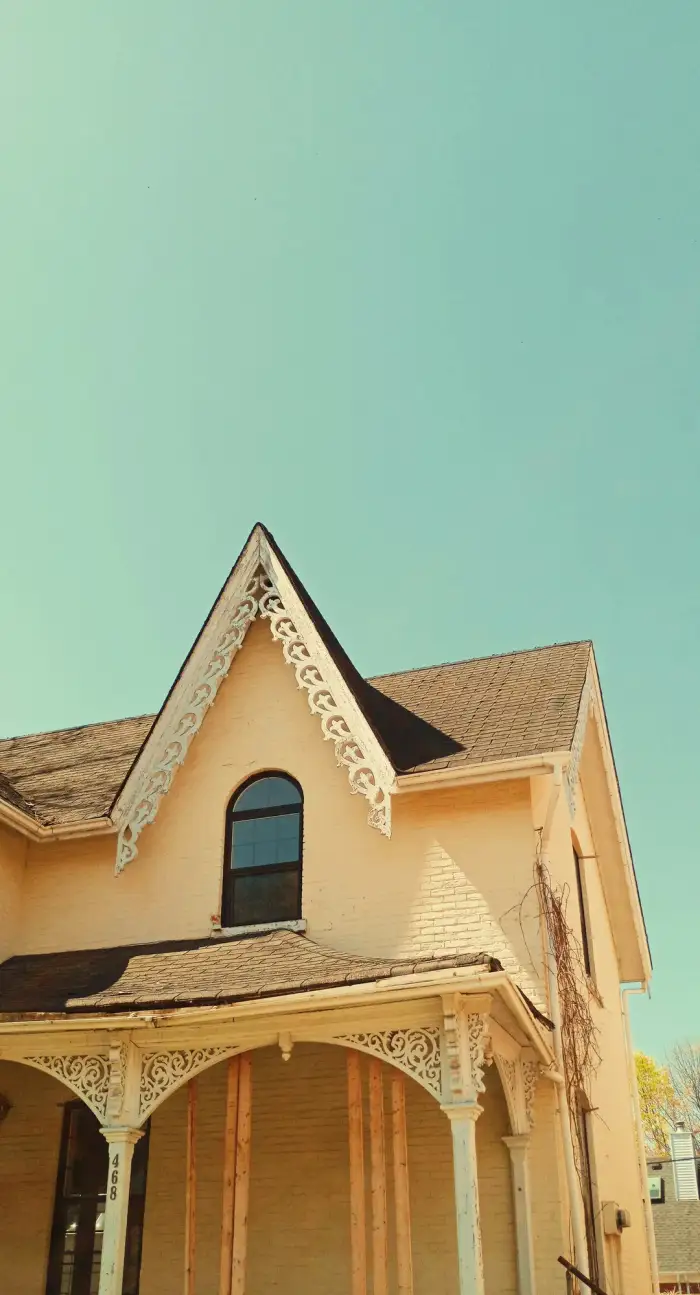
The gable dormer is the most classic type, with a triangular or arched pediment crowning the window, austere or ornate depending on the style. The shed dormer follows the roof slope and stays more discreet, often used when the attic space is converted to living quarters. The bull's-eye dormer (oeil-de-boeuf) is a round or oval window often placed near the ridge, purely decorative in many cases, adding refinement to the roofline that catches the eye from the street. The hip dormer, with its own small hip roof, is the most complex, costliest, and most sumptuous of the four.
Preserving original dormers is a heritage priority. Replacing them with plastic reproductions or sealing them to eliminate maintenance permanently destroys a home's character.
Maintaining a Heritage Roof
A roof should never be ignored until it leaks. Annual inspection (ideally in spring, after frost-thaw cycles) allows problems to be detected before they become catastrophic.
The priority inspection points: condition of slates, shingles, or metal panels (cracks, slipping, corrosion), mortar joints around chimneys, condition of flashings (metal pieces sealing junctions between roof and wall, roof and dormer, roof and chimney), gutters and downspouts (blockage, deformation, joint failure), and attic ventilation (condensation, excessive moisture).
Approximate material service life:
| Material | Service Life |
|---|---|
| Natural slate | 75 to 150 years |
| Copper sheet | Unlimited (patina) |
| Galvanized steel (well maintained) | 40 to 60 years |
| Cedar shingles | 20 to 40 years |
| Premium asphalt shingles | 25 to 40 years |
| Flat roof membrane (TPO/EPDM) | 15 to 25 years |
To find a roofer with heritage restoration expertise, or a home renovator used to older buildings: APMAQ, municipal heritage councils' reference lists, and provincial contractors' associations (ACQ, APCHQ) can point to firms with documented experience on old buildings. In the larger centres, see roofers in Montreal or roofers in Quebec City.
Frequently Asked Questions
How do I know if my roof should be repaired or replaced?
A roof that still has more than 30% of its useful life can often be repaired rather than fully replaced. Signs that full replacement is needed: slates or shingles crumbling en masse, rotted sheathing, framing affected by moisture. Localized leaks, isolated broken slates, or corrosion on a few metal panels are typically repairable without full replacement.
Can the roofing material be changed on an old house?
Technically yes, but architectural compatibility (certain materials are associated with certain styles) and municipal requirements in heritage zones must be considered. Replacing slate with asphalt shingles on a Victorian home means a loss of authenticity and market value. The rule: prefer materials compatible with the period of construction.
What is flashing, and why is it so important?
Flashing is the metal piece (copper, lead, or aluminum) that waterproofs the junction between the roof and a vertical wall, a chimney, a dormer, or a valley. It's the number-one weak point on old roofs: improperly installed, cracked, or frost-heaved flashing causes major infiltration even when the roof covering itself is sound. Inspect it first.
My house has a false mansard, what should I watch for?
The integrity of the flat roof behind the decorative facade. Ensure drains are functioning and unobstructed. Check the condition of the membrane or flat roof waterproofing annually, standing water is a sign drainage is compromised. The space between the false mansard and the flat roof must also be ventilated to prevent condensation and rot in the cladding.
How much does a heritage roof replacement cost?
It depends on material and area. A natural slate roof on a medium-sized home runs $25,000 to $60,000. Standing-seam metal: $15,000 to $35,000. Cedar shingles: $12,000 to $25,000. For homes in a heritage zone, municipal or provincial grants can cover 30% to 50% of costs, check with your municipal planning office before signing a contract.
Ready to start your project?
Describe your work, choose how many quotes you want to receive, and compare qualified contractors near you. Free and no commitment.