Kitchen Renovation Cost in Quebec
A kitchen renovation is the most-requested home project in Quebec, and the one where budgets blow up the most. In 2026, the average full kitchen renovation lands around 35 000 $, but the realistic range runs from 19 000 $ for a modest refresh to over 60 000 $ for a premium overhaul. The gap isn't really about quality. It's driven by four variables: scope of work, cabinet material, plumbing relocation, and appliance choice. Here's how the money actually breaks down line by line, and where the real levers are to adjust the budget.
The three price tiers by scope
Entry level: 19 000 $ to 25 000 $. You keep the existing layout, swap the cabinets (melamine or thermoplastic on standard boxes), replace the countertop (high-end laminate or entry-level quartz), repaint the walls, install a simple backsplash. Existing appliances stay. Typical duration: 4 to 6 weeks.
Mid-range: 30 000 $ to 45 000 $. Partial layout change (sink or island relocation without structural work), thermoplastic or quality wood cabinets, quartz countertop, ceramic backsplash, half the appliances replaced, layered lighting redesign. Typical duration: 7 to 10 weeks.
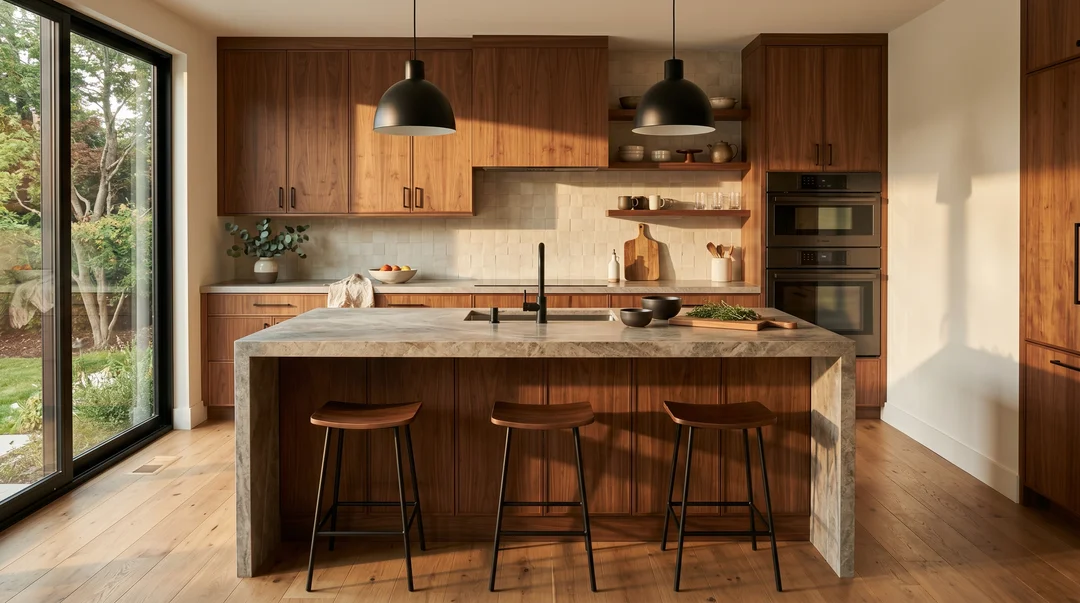
Premium: 50 000 $ to 80 000 $ and up. Full redesign, custom cabinets in solid wood or premium veneer, natural stone or premium quartz counter (3 cm thick), island with a different top surface, integrated high-end appliances, plumbing and electrical relocation, possibly a wall removed. Typical duration: 12 to 18 weeks, custom cabinet fabrication included.
Below 19 000 $, it's no longer a renovation but a refresh: painted cabinets, new handles, simple countertop. Above 80 000 $, you cross into custom architectural territory with dedicated cabinetmaker and personalized plans.

Cost breakdown by line item: where the money actually goes
On an average kitchen renovation, the typical split runs like this:
| Line item | Share of budget | Range on 35 000 $ |
|---|---|---|
| Cabinets (boxes + doors + drawers) | 35 to 45 % | 12 000 $ to 16 000 $ |
| Countertops (material + install) | 12 to 18 % | 4 000 $ to 6 500 $ |
| Appliances (if replaced) | 8 to 15 % | 3 000 $ to 5 500 $ |
| Plumbing and electrical (rough-in + finish) | 8 to 12 % | 3 000 $ to 4 500 $ |
| Flooring (if replaced) | 6 to 10 % | 2 000 $ to 3 500 $ |
| Backsplash (material + install) | 3 to 5 % | 1 000 $ to 1 800 $ |
| Wall paint and finish | 2 to 4 % | 700 $ to 1 500 $ |
| General contractor coordination | 8 to 12 % | 3 000 $ to 4 500 $ |
Cabinets are consistently the heaviest line. They're also where the gap between cheap and high-end is most dramatic: 5 000 $ in melamine versus 25 000 $ in custom solid wood for the same square footage. That's the main lever to adjust a budget up or down.
The variables that swing a budget
Cabinet material. Melamine runs 70 $ to 110 $ per linear foot, thermoplastic 120 $ to 200 $, veneer wood 180 $ to 280 $, solid wood custom 350 $ to 600 $ and up. On a standard 25 linear-foot kitchen, that's a gap of 4 000 $ to 12 000 $ on that line alone.
Plumbing and electrical relocation. Keeping the sink and stove where they sit costs nothing extra. Moving them means opening floors or walls (1 500 $ to 4 000 $), electrical recertification, sometimes panel upgrade if you switch to induction (dedicated 40 A circuit). A reconfigured kitchen typically costs 6 000 $ to 12 000 $ more than a kitchen redone in the same footprint.
Appliances. An entry-level suite (fridge + stove + dishwasher + range hood) runs around 3 500 $. The same suite in high-end brands (Bosch, KitchenAid, Miele) easily climbs to 12 000 $ to 20 000 $. This is purely a personal call: mid-range appliances last 12 to 15 years, high-end 15 to 25 years with more features.
Square footage. A small 15 linear-foot kitchen costs about 60 percent of an average 25 linear-foot kitchen, but not 60 percent in linear proportion. It's 60 percent in absolute terms because some fixed costs (contractor, mobilization, permit, appliances) don't shrink with surface.
The hidden costs no one mentions
Municipal permit. 150 $ to 400 $ depending on the borough. A renovation permit is required as soon as you modify main plumbing, the main electrical panel, a partition wall or any opening. Repainting and swapping cabinets without touching the rest usually doesn't need one. Check with the municipality.
Electrical upgrade. If you move to induction (40 A range) or add a wall oven on top of the stove, your electrical panel may have to jump from 100 A to 200 A. Plan 1 500 $ to 2 800 $ with a licensed electrician.
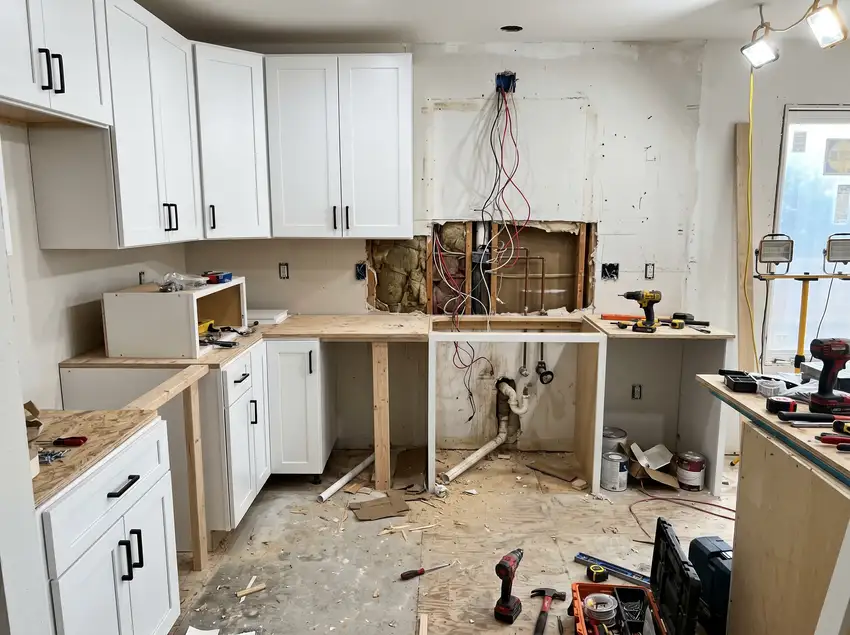
Hazardous materials handling. Kitchens in homes built before 1990 often have asbestos in the old vinyl flooring or in the plaster walls. If you have to break a wall, a test (300 $ to 500 $) is required, and professional removal adds 2 000 $ to 6 000 $.
Surprises behind the walls. Lead drains to replace, joists to reinforce, electrical that's out of code, infiltration in the back wall, aging galvanized plumbing. It's rare for a kitchen renovation to surface none of these. Hold a contingency reserve of 15 to 20 percent of the total budget.
Eating out during the work. During the 2 to 4 weeks without a stove or sink, many families spend an extra 300 $ to 800 $ on takeout and restaurants. Worth budgeting if the renovation runs over 6 weeks.
How to keep your budget realistic
Set your ceiling before you shop, not after. The classic trap: you walk into a showroom, fall in love with a 55 000 $ kitchen, start with a 30 000 $ mental budget, and rationalize every overrun. The final total is consistently 40 to 60 percent higher than the original budget.
Hold 15 to 20 percent as a contingency reserve. This isn't an optional cushion, it's a separate line in your budget. If you don't have it, push the start date. A 5 000 $ overrun that forces you to halt the project mid-stream costs more in delays and demobilization than budgeting for it from the start.
Prioritize line items that age well. High-end cabinets and quartz counters last 25 years and up. Appliances have a 12 to 15-year lifespan, so even high-end you'll replace them once during the kitchen's lifetime. The 25-year math always favours cabinets and counters, rarely premium appliances.
Request three detailed bids. The method for comparing contractor quotes applies line by line on a kitchen. The spread between cheapest and priciest can hit 40 percent on the same project. A general contractor who coordinates plumbing, electrical, carpentry and finish often comes out cheaper than hiring each trade separately, because of the coordination cost. For custom cabinets, a cabinetmaker works the project directly: see cabinetmakers in Quebec City or cabinetmakers in Montreal.
Avoid the mistakes that blow up the budget. Before finalizing, read the 7 kitchen renovation mistakes to dodge: picking finishes before the layout, skipping the permit, cutting corners on plumbing. And check which profitable renovations you can bundle into the same project to amortize fixed costs.
Frequently Asked Questions
How much does a typical kitchen renovation cost in Quebec in 2026?
The realistic range runs from 19 000 $ for a modest upgrade to 60 000 $ for a full overhaul. The 2026 national average lands around 35 000 $ for an average-sized kitchen with thermoplastic cabinets, quartz counter, mid-range appliances, and minor plumbing relocation.
What's the most expensive line item in a kitchen renovation?
Cabinets consistently represent 35 to 45 percent of the total budget, the heaviest single line. They're also where the gap between entry-level and custom is most dramatic (5x difference), so the main lever to adjust your budget.
How long does a kitchen renovation take?
4 to 6 weeks for a modest renovation (cabinets, counters, paint), 7 to 10 weeks for mid-range with minor plumbing relocation, 12 to 18 weeks for a premium overhaul including custom cabinet fabrication (often 8 to 12 weeks just for the cabinets).
Can you stage a kitchen renovation to spread the cost?
Yes, but it rarely pays off. Doing cabinets in year 1 then counters in year 3 means paying the contractor's mobilization twice, disrupting the kitchen twice, and missing the scale economies of coordination. Better to wait for the full budget or finance it in one block.
What's the resale return on a renovated kitchen?
A well-executed kitchen recovers 60 to 80 percent of its cost at resale, provided it's consistent with the rest of the home and the neighbourhood market. Spending 60 000 $ on a kitchen in a 350 000 $ home gives a disappointing return: the kitchen is oversized for the property. Keep the renovation proportional to the home's value.
Ready to start your project?
Describe your work, choose how many quotes you want to receive, and compare qualified contractors near you. Free and no commitment.