Interior Design Trends 2026: 10 Ideas Transforming Our Spaces
Interior design in 2026 is turning its back on the cold, minimalist excess of the previous decade. The pendulum is swinging back toward warmth, texture, and authenticity, spaces that feel genuinely lived-in, materials that age beautifully, and rooms that breathe. The shift isn't about adding more. It's about choosing better.
Whether you're planning a full renovation or simply want to refresh a few rooms, here are the 10 trends shaping interiors in 2026.
1. The Return of Raw Natural Materials
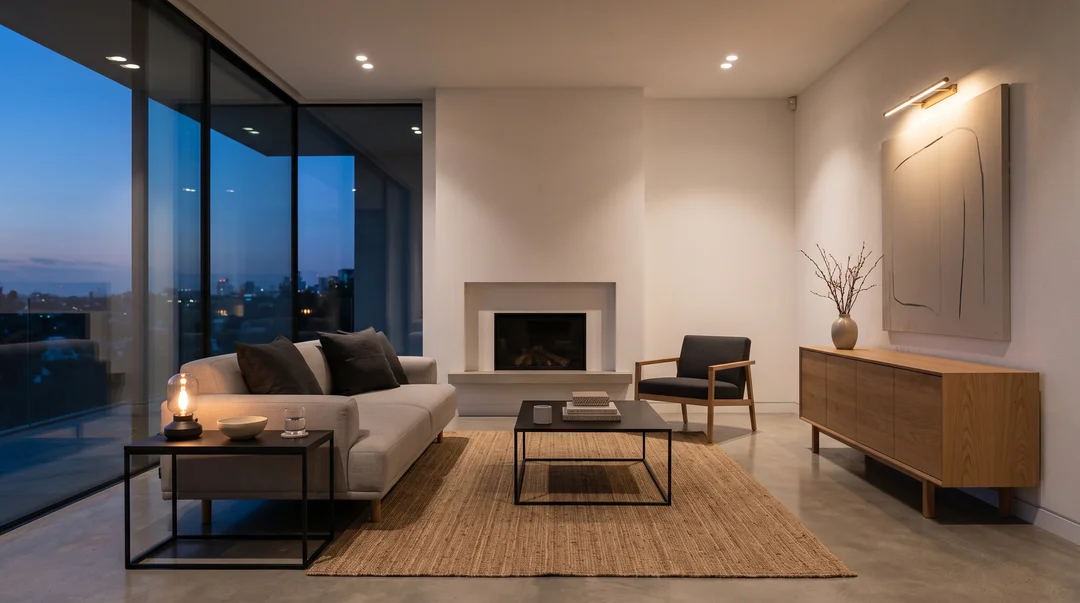
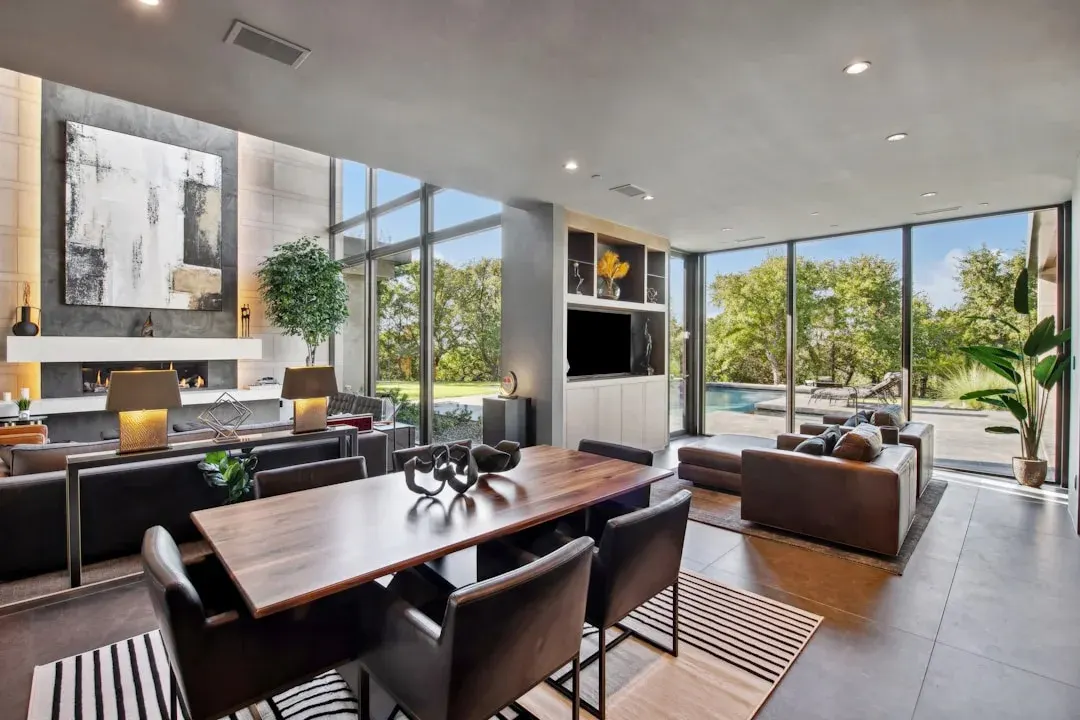
Wood, stone, travertine, polished concrete, cork, materials that carry the passage of time are everywhere in 2026. They're chosen not despite their imperfections, but because of them. A stone countertop with natural veining, a hardwood floor with visible knots, a polished concrete wall that catches light differently at different hours of the day.
The approach that works is to pick one natural material per room and let it dominate. A travertine backsplash in the kitchen, a stone sink in the bathroom, an exposed beam in the living room, one strong element consistently beats five timid ones. Travertine backsplash runs $80 to $180/sq. ft. installed. Natural quartz or granite countertop: $60 to $150/sq. ft.
2. Terracotta, Sage Green, and Warm Beige
The bright white and neutral gray that ruled interiors from roughly 2015 to 2022 are fading out. The colors taking over in 2026 are organic, calming, and slightly desaturated: terracotta in soft red-orange, sage green in an ashy muted tone, warm beige running from butter to light caramel, and deep midnight blue as a strong accent. These tones work together or separately, and they pair naturally with raw materials and indoor plants.
Cabinet doors are the lowest-cost place to test a trend color. Repainting kitchen cabinets in sage green and swapping the hardware for brushed brass produces a transformative result for under $500.
3. The Clean, Two-Tone Kitchen
The 2026 kitchen has two defining characteristics: two colors (usually light on top, dark on the bottom) and a streamlined profile with no visible handles. Push-to-open drawers or integrated rail pulls replace traditional hardware on upper cabinets, while the lower cabinets anchor the room in forest green, midnight blue, or charcoal.
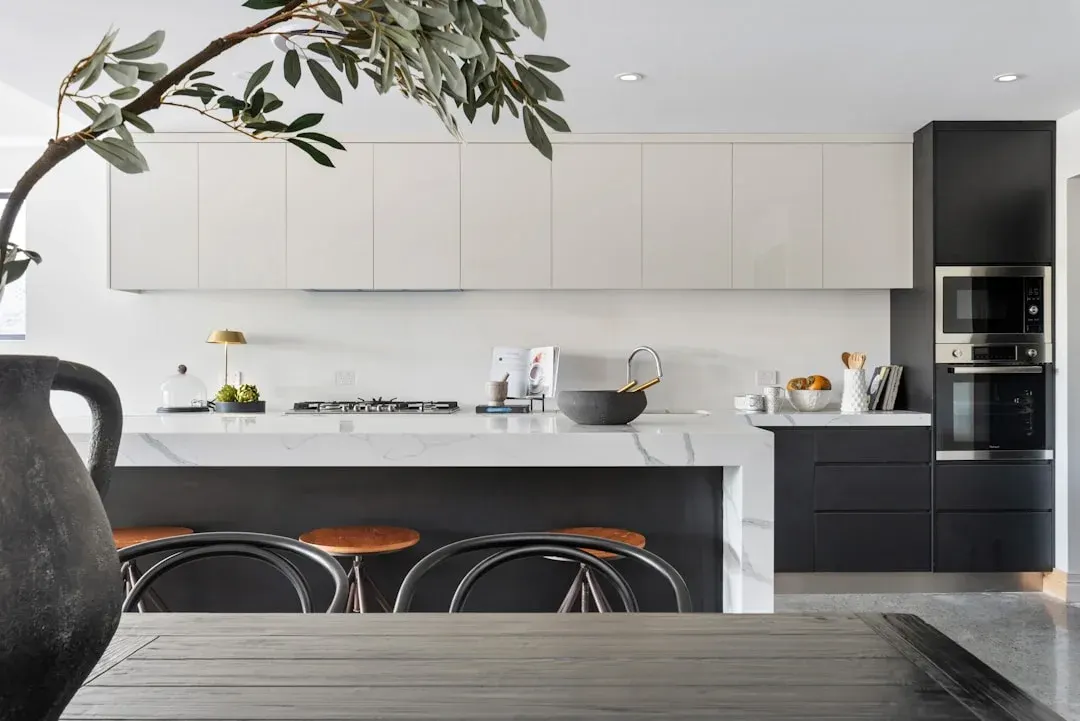
A white or marble quartz countertop floats above the darker lower cabinets while upper cabinets stay light or disappear entirely in favor of open shelving. The effect is a room that feels simultaneously larger and more sophisticated. The details that make it work: brushed brass or matte black hardware (chrome is out), an undermount or farmhouse apron sink, a statement range hood in steel or stone, and integrated LED under-cabinet lighting. A mid-size kitchen renovation with painted cabinets, new countertop, and fixtures runs $15,000 to $35,000, typically entrusted to a home renovator. Repainting existing cabinets and swapping hardware only: $2,000 to $5,000.
4. The Bathroom That Feels Like a Spa
The 2026 bathroom is no longer a utilitarian room, it's a sanctuary. The influence of luxury hotels and Asian spa design is unmistakable: a walk-in shower with no threshold, a floating vanity, matte black fixtures, warm ambient lighting, and materials that evoke nature.
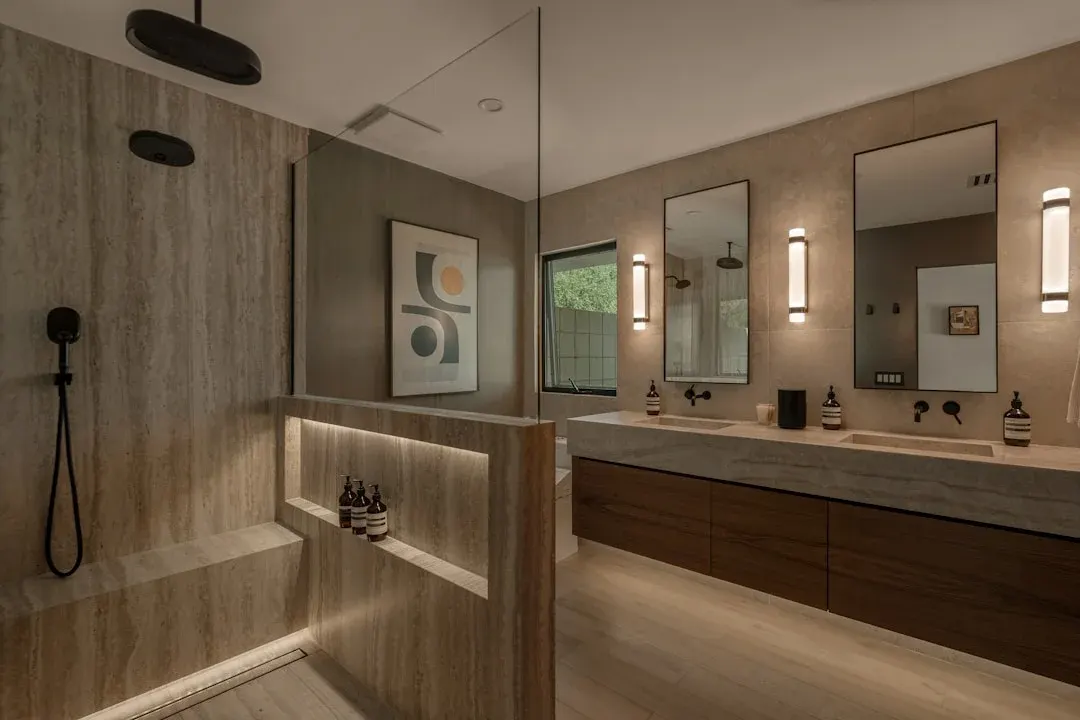
The elements that define the look are a curbless walk-in shower with large-format tiles (24×48 inches or larger), a ceiling-mounted rain showerhead with a side handshower, a floating vanity with drawers and indirect lighting underneath, a framed or recessed mirror with integrated lighting, and radiant floor heating under tile. A freestanding or undermount soaking tub rounds out the room if space allows. A bathroom renovation with walk-in shower, new vanity, and tile runs $12,000 to $30,000 for a standard-size room.
5. The Arch Is Back
The architectural arch is making a strong comeback in 2026, not just in Mediterranean-inspired homes. It frames openings between rooms, creates built-in alcoves, anchors a headboard wall, or simply breaks the monotony of right angles throughout a space.
Arches add softness, character, and a sense of luxury without requiring major structural work. A well-executed drywall arch, painted the same tone as the surrounding walls, can completely transform a room. The opening between a hallway and living room, or between kitchen and dining area, is usually the ideal spot. Expect $800 to $2,500 for construction and finishing, depending on complexity.
6. Textured Accent Walls as the Focal Point
The accent wall is having its moment, but in 2026 it goes well beyond a contrasting paint color. Textured walls dominate: wood slat panels, fluted MDF panels, Venetian plaster, wainscoting, large-format textured ceramic tile. The goal is a single surface that stops the eye and anchors the room, behind the bed in the bedroom, behind the TV in the living room, behind the vanity in the bathroom.
Popular options and their installed costs: slat walls made from wood strips run $25 to $50/sq. ft. with a warm, modern feel; Venetian plaster or lime wash runs $15 to $35/sq. ft. with an organic, artisanal texture; fluted MDF panels come in at $20 to $45/sq. ft. with a geometric, sophisticated look; and wainscoting or panel molding runs $10 to $30/sq. ft. for a classic revisited.
7. Matte Black Hardware Everywhere
Polished chrome is behind us. Matte black hardware moves through the kitchen, bathroom, and laundry room in 2026 (it offers strong contrast, hides water spots beautifully, and works equally well in light or dark spaces. Brushed brass, a soft warm gold rather than anything shiny, remains popular as a warmer alternative. The rule that applies to both finishes: pick one and carry it through every metal element in the room) faucets, handles, towel bars, hooks. Mixing finishes kills the effect. A quality matte black shower faucet set runs $400 to $1,200. Swapping fixtures alone in an existing bathroom is one of the highest-impact, lowest-cost updates you can make.
8. Sculptural Lighting as Art
The 2026 light fixture isn't just functional (it's the centerpiece of the room. Woven rattan pendants, hand-blown glass globes, linear raw metal chandeliers, handcrafted ceramic table lamps) lighting is chosen the way you'd choose a sculpture. Trends worth watching include linear pendants above the dining table replacing the traditional chandelier, wall sconces with linen or parchment shades, architectural floor lamps with thin metal stems, and rattan or bamboo pendants in high-ceiling rooms.
One practical note: don't underscale your lighting. A pendant above a dining table should span 50-66% of the table's width. A fixture that's too small does more harm than good.
9. Indirect and Integrated Ambient Lighting
Alongside sculptural lighting, architectural integrated lighting is growing rapidly in 2026. LED strips hidden in ceiling coves, under kitchen cabinets, beneath floating vanities, along stairways (the idea is that light appears to emanate from nowhere in particular. This ambient lighting creates volume, warmth, and depth. Paired with dimmers, it allows you to shift the feel of every room based on time of day and how the space is being used. For color temperature, 2700K-3000K is right for living spaces) warm and inviting. Reserve 4000K for task areas like the kitchen island or a home office desk.
10. Eco-Renovation and Sustainable Materials
Environmental awareness is no longer an optional extra (it's reshaping material choices across renovation projects of all sizes. Wood fiber and hemp insulation, clay-based zero-VOC paints, eco-friendly flooring like bamboo and reclaimed cork, tiles made from recycled glass) these materials are appearing in kitchens, bathrooms, and living rooms alike. They're no longer visually austere. They're beautiful, durable, and they tell a story. For the biggest impact on energy consumption and comfort, thermal insulation and window replacement are where eco upgrades matter most. Government incentive programs can cover part of the cost, check eligibility before planning the work.
How to Integrate Trends Without Regrets
Not every trend is right for every home, and not every trend suits every budget. A few principles help.
Separate the permanent from the temporary. Wall colors can change; bathroom tile cannot. Apply durable trends (arches, natural materials, walk-in showers) to permanent elements, and save more fleeting ones (accent colors, textiles, accessories) for things that are easy to replace. Start with the details. Matte black hardware, brushed brass handles, a sculptural light fixture, these are high-impact changes for modest budgets. Transform what you have before replacing everything. And think coherence rather than collection. You don't need every trend. Pick two or three ideas that genuinely resonate with your life and build your interior around them. A coherent, personal space is worth infinitely more than a home that chases every wave.
Frequently Asked Questions
Are design trends worth following when planning a renovation?
Yes (to the extent that they point you toward choices that will still look good in 5-10 years, not just what's viral this season. The 2026 trends) natural materials, matte finishes, walk-in showers, are lasting evolutions rather than passing fads. Avoid making permanent choices in tile or built-in cabinetry purely because something is trending right now.
How much does a renovation that follows current trends cost?
It depends entirely on scope. Refreshing an existing kitchen with painted cabinets, a new countertop, and new fixtures runs $5,000 to $15,000. A full bathroom renovation with current-trend finishes costs $15,000 to $35,000. Decorative additions (lighting, a textured wall, fresh paint) run $1,000 to $5,000 per room.
Which updates deliver the best return on investment at resale?
Kitchen and bathroom consistently deliver the best ROI. In the kitchen: hardware, cabinets, and countertop. In the bathroom: the walk-in shower and vanity. Modern, quality finishes in these two rooms directly influence how buyers perceive the rest of the home.
Is white still popular in 2026?
Pure white is giving way to off-whites, warm beiges, and creams, tones that pair better with natural materials. If you love light interiors, choose a warm white with a light reflectance value around 85-90, rather than a stark optical white that can feel cold under certain lighting conditions.
How do I know if a trend suits my home's style?
Follow the existing architecture. A Victorian or 1950s bungalow will welcome arches and panel molding far more naturally than an ultramodern space. A flat-roof or clean-lined home will gravitate naturally toward raw materials and geometric surfaces. An hour with an interior designer can prevent mistakes that are expensive to undo.
Ready to start your project?
Describe your work, choose how many quotes you want to receive, and compare qualified contractors near you. Free and no commitment.